
East West Pipeline Red Sea Risk and the Wider Tanker Market
Saudi exports are recovering through both Hormuz and Yanbu, but the additional barrels are moving through a vessel intensive system that has not restored normal tanker availability or voyage costs.
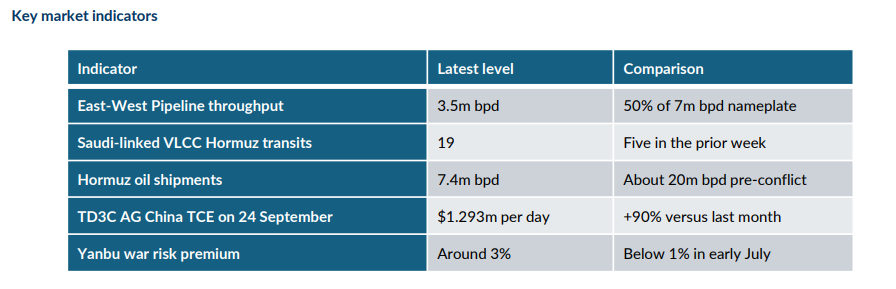
This week's Allied QuantumSea Research reviews the latest phase of Saudi crude export recovery. The East-West Pipeline is moving about 3.5 million barrels per day and overseas shipments from Yanbu have resumed. Saudi-linked VLCC transits through Hormuz have also reached their highest weekly level since the conflict began. The additional volume is important, but the operating system still depends on protected passages, ship-to-ship transfers, elevated war-risk cover and restricted owner acceptance around Bab el-Mandeb.
Saudi export recovery is material but remains operationally constrained
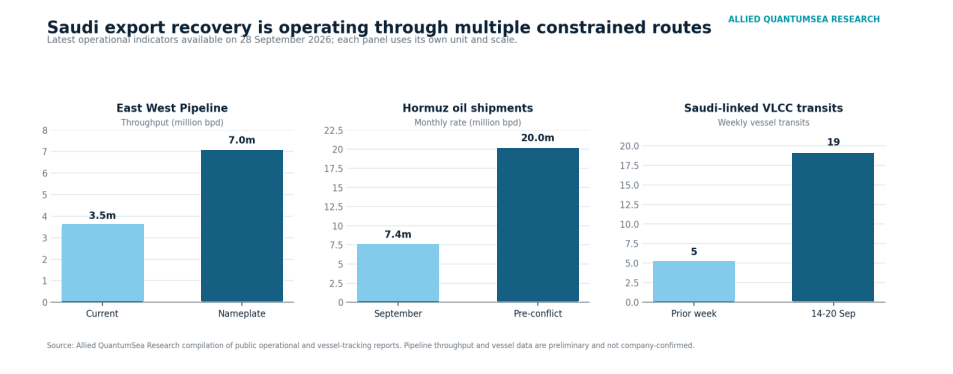
September oil shipments through Hormuz are estimated at approximately 7.4 million barrels per day, while combined crude exports from the principal Middle East producers have recovered to 12.8 million barrels per day, the highest level since the conflict began in February. Hormuz flows nevertheless remain well below the approximately 20 million barrels per day that passed through the strait before the conflict. The recovery is concentrated on crude tankers rather than a broad return of commercial shipping. Preliminary vessel tracking recorded 19 Saudi-linked VLCC transits during 14-20 September, up from five in the previous week and the highest weekly total since the conflict began. These figures show that Saudi Arabia is restoring exports through two constrained routes at the same time. Higher Gulf loadings support VLCC employment and shuttle demand, while renewed pipeline flows shift part of the loading programme back toward Yanbu without removing Red Sea insurance and passage risk.
Higher exports have not produced cheaper freight
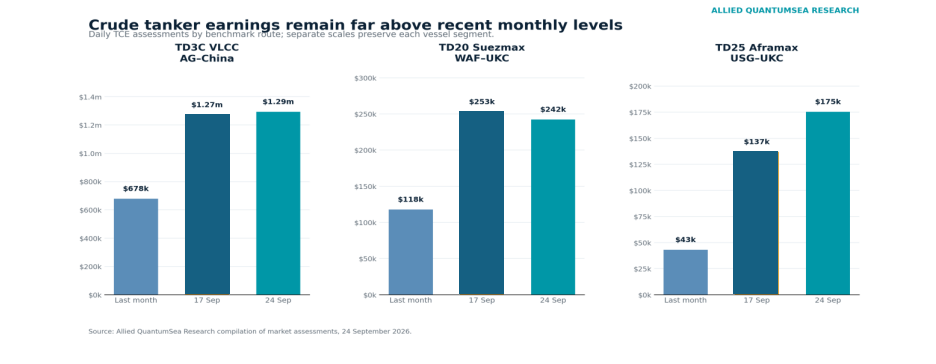
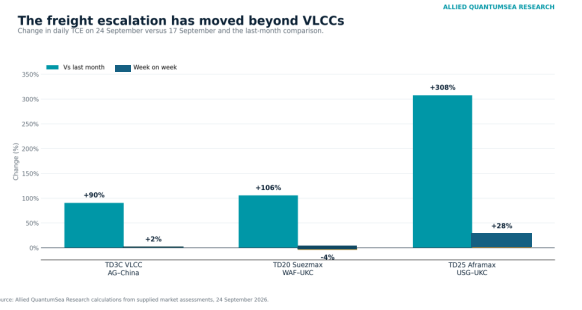
Daily TCE assessments on 24 September remained well above their recent monthly comparisons. The TD3C Arabian Gulf–China VLCC assessment increased marginally to $1.29 million per day from $1.27 million on 17 September, compared with $678,000 last month. TD20 West Africa–UK Continent Suezmax earnings eased to $242,000 per day from $253,000 but remained more than double the last-month level of $118,000. TD25 US Gulf–UK Continent Aframax earnings strengthened further to $175,000 per day, up from $137,000 on 17 September and approximately four times the last-month assessment of $43,000.
The bypass has its own maritime constraint
The East-West Pipeline has resumed overseas exports after an attack damaged three pumping stations and interrupted Yanbu shipments for 17 days. Flows through the line reached approximately 3.5 million barrels per day on 28 September. This is a significant improvement from the initial low-rate restart but remains half of the pipeline's 7 million-barrel-per-day nameplate capacity. The allocation between west-coast refineries and export storage has not been disclosed, and Saudi Aramco has not publicly confirmed the reported throughput.
This separates the onshore and maritime parts of the Saudi bypass. The return of pipeline flow restores the ability to move crude from the Eastern Province to the Red Sea, but it does not ensure that sufficient tanker capacity will accept the onward voyage. Consecutive completed Yanbu loadings will therefore matter more for the freight market than pipeline throughput alone. War-risk premiums quoted for Saudi-linked tankers calling at Yanbu have risen to approximately 3% of vessel value, from below 1% in early July. Premiums for Saudi ports farther south have been quoted as high as 7%, close to the 6% to 9% range associated with Hormuz transits. For a tanker loading at Yanbu, the insurance component alone can reach approximately $3 million for the voyage.
Asian cargoes loaded at Yanbu must normally sail south through Bab el-Mandeb. The alternative of moving north through Suez and then around southern Africa to reach Asia adds approximately 22 days to the voyage. It also increases bunker consumption, charter duration and effective tonne-mile demand. The bypass therefore shifts the location of the risk rather than eliminating it. The commercial decision is no longer based only on whether Yanbu can load a vessel. It also depends on whether the owner, insurer and crew will accept the subsequent passage and at what additional cost.
Ship to ship transfers remain embedded
Ship-to-ship crude transfers near Oman increased to approximately 2.5 million barrels per day in September, from 1.4 million barrels per day in August. Saudi export arrangements have included about 60 million barrels for September and October loading from Ras Tanura, followed by transfer near Sohar. This structure uses one vessel to move crude through or out of the Gulf and another for the main ocean voyage. It increases the number of vessel movements required for the same cargo volume and can keep both the shuttle tanker and the receiving vessel occupied during positioning, waiting and transfer operations.
The continued increase in transfer activity, alongside the higher cost of using Yanbu, indicates that STS operations are not simply a temporary measure awaiting pipeline repair. They remain part of the current export system because neither Hormuz nor the Red Sea offers an unrestricted and consistently low-risk route.
The escalation is spreading beyond VLCCs
The latest assessments show that the freight escalation is no longer confined to Arabian Gulf VLCC employment. VLCC earnings held close to the previous week’s exceptional level, while Suezmax earnings remained more than double their last-month comparison despite a modest weekly correction. The strongest fresh momentum came from the Aframax market, where earnings continued to rise sharply.
This shift points to a wider tightening across the crude-tanker complex. Atlantic owners are pricing the opportunity cost of repositioning vessels toward the East, while longer replacement-crude voyages from the Americas and West Africa are competing for tonnage already affected by Gulf shuttle demand, STS operations and extended voyage duration. The result is a broader reduction in effective vessel availability, with the strongest acceleration now visible outside the VLCC segment.
Fuel remains expensive but is not the sole driver
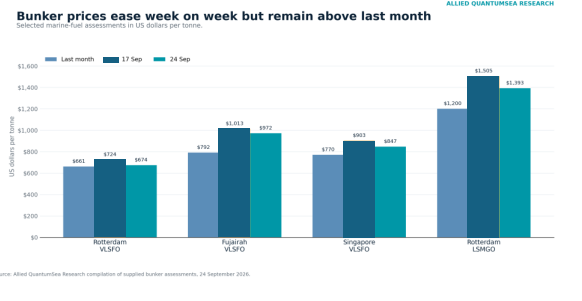
Marine fuel prices declined during the latest week, but most remained above their comparisons last month. Fujairah VLSFO fell to $972 per tonne from $1,013 but remained 23% above last month. Singapore VLSFO declined to $847 from $903 and remained 10% higher than last month. Rotterdam LSMGO eased to $1,393 from $1,505, while remaining 16% above the monthly comparison.
The combination of declining weekly bunker prices and rising VLCC and Aframax earnings is important. It shows that the latest freight escalation cannot be explained by fuel costs alone. Security exposure, restricted owner acceptance, STS operations and the loss of productive vessel time play a larger role in freight pricing.
Crude tanker market outlook
There is no implemented US-Iran agreement to reopen Hormuz, and no timetable on which owners, charterers or insurers can base a return to normal operations. The East-West Pipeline is moving at a meaningful volume and Yanbu exports have resumed, but the Red Sea route still carries elevated insurance and acceptance constraints.
The crude market is consequently moving from dependence on one disrupted corridor to reliance on several constrained systems. Hormuz passages remain connected to protected movements, shuttle employment and STS operations. East-West Pipeline flows remain exposed to Yanbu and Bab elMandeb risk. Atlantic replacement barrels require longer voyages and compete for VLCC, Suezmax and Aframax capacity.
This is the basis of the current freight escalation. Export volumes can recover without restoring vessel productivity. In the near term, the combination of higher Gulf loadings and a partial return of Yanbu exports keeps more crude in motion across routes with different security and insurance constraints. Until transit risk, insurance costs and operating time decline together, the return of physical barrels is more likely to sustain tanker demand than to provide immediate freight relief.
Indicators for the next adjustment
• Whether East-West Pipeline throughput remains near 3.5 million barrels per day and consecutive Yanbu loadings are completed.
• Whether Saudi-linked VLCC transits remain above the September 14-20 total of 19 after the pipeline restart.
• Owner acceptance and war-risk quotations for Yanbu and Bab el-Mandeb passages.
• Whether Oman STS volumes retreat from the September level of 2.5 million barrels per day.
• Persistence of TD20 and TD25 earnings above their last-month and Q3 FFA comparisons.
• Any implemented security or diplomatic arrangement that changes transit conditions rather than only political expectations.
Data Source: Allied
Data note
Freight and bunker benchmarks reflect the supplied market table dated 24 September 2026. Percentage comparisons are calculated from the displayed TCE values. Pipeline, export and vessel-transit figures reflect public operational and tracking updates available through 28 September 2026. Pipeline throughput has not been confirmed by Saudi Aramco. Shipment and transit estimates are preliminary, use different measurement scopes and may be revised. AIS-based movements may be undercount protected or non-transmitting vessels.