
By Mary Melton
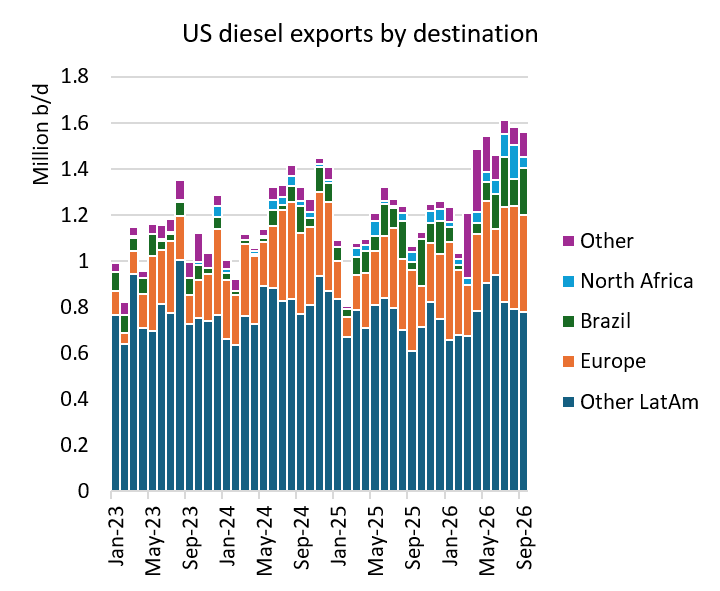
The US diesel export ban, that Mr. Trump has floated as a means of cutting domestic diesel prices in the run-up to the midterm elections, would remove or reduce one of the largest sources of MR employment in the Atlantic. While tonne-miles would increase as Europe and Brazil replace lost US diesel with barrels from the Middle East and Asia, much of that benefit is likely to accrue to LRs rather than MRs. A sustained ban, however unlikely, from the exporter of 1.57m b/d (20%) of global seaborne diesel would be negative for all clean tankers. Tightened cargo availability would likely increase prices to the point of widespread demand destruction.
How likely is the ban?
We believe some form of a US diesel ban is now likely enough to merit us looking at the impact to imports and tanker demand for regions most dependent on diesel imports. With five weeks to go until the US midterm elections, Mr. Trump was on Sunday “thinking very seriously” about a US diesel export ban. Despite mixed signals from Washington about whether a ban will happen and what form it could take, the threat alone may already be achieving the desired effect. As of Friday, spot US Gulf coast diesel prices fell 48.75 ¢/gallon (-10%) compared to the week before, according to Argus.
Europe and Brazil would look East
Europe imported roughly 45% (500k b/d) of its non-European diesel from the US over the last month. Brazil has sourced two-thirds (137k b/d) of its diesel imports from the US since August. Both Europe and Brazil would be forced to look to the East of Suez for replacement cargoes in the case of a US export ban.
Sourcing replacements from the East would increase voyage length and would tend to favour LRs over MRs. A voyage from the Middle East Gulf or West Coast India to Northwest Europe via the Suez Canal is about 25% to 30% longer than one from the US Gulf to NW Europe, while the same voyages around the Cape of Good Hope are more than twice as long as a US Gulf voyage to NW Europe. This month, around 90% of European diesel imports from the Middle East Gulf or India transited the Red Sea, compared to 10% around the Cape of Good Hope. A voyage to Brazil from the West Coast of India or the Middle East Gulf is roughly 2.5 times longer than a US Gulf to Brazil voyage.
Europe and Brazil would also have to compete more aggressively with East and South Africa, Oceania and Southeast Asia for East of Suez cargoes. Although India could be a likely source of replacement cargoes for Europe, the EU ban on fuel imports refined from Russia crude is still in place. Unless this ban is lifted, this could make it more likely these barrels go to Brazil, the UK or Turkey, or stay within the East as other cargoes go west.
China has also been a crucial swing supplier of diesel in recent months. Its diesel exports have increased from 204k b/d in July to 465k b/d so far this month, marking the highest exports since late 2022. However, the reimposition of China’s refined product export restrictions - in place from March through early July this year - could remain a risk if crude supply is disrupted.
Even though LRs are most likely to benefit from all the above shifts, there could be a shortage of clean-trading ships, as 69% of the LR2 fleet is currently trading dirty. This means some East-to-West replacement cargoes could move on MRs. Alternately, as has happened in the past, these cargoes could move on uncoated newbuildings.
Other diesel import regions face constraints
The biggest challenge for all regions reliant on diesel imports is that replacement barrels to cope directly or indirectly with lost US supply are limited.
Russia’s diesel cargoes have all but dried up as its export ban continues amidst the ongoing Ukrainian attacks on Russian refineries. The Mediterranean region, particularly Turkey and Morocco, has imported100k b/d of Russian diesel so far this month according to cargo tracking data, compared to the Q2 average of 465k b/d. Brazil received its last Russia diesel cargo over a month ago.
The Middle East as a replacement supplier is uncertain. Diesel exports from Saudi Arabia’s Red Sea ports fell by 305k b/d to 122k b/d during the third week of September, after attacks on the Jizan refinery on 8 September and the E-W pipeline on 11 September. Red Sea diesel exports recovered to 464k b/d last week, but the Jizan refinery could be offline until at least the end of the year, and the availability of crude feedstock for the other Red Sea refineries depends on continued operation of the E-W pipeline.
The Middle East Gulf appears to be the more promising Mideast source of replacement diesel barrels, but this depends on the security situation. Reports are emerging of another VLCC attacked in the early hours of this morning, which could change the risk calculus for exporters. Diesel exports through the Strait of Hormuz have more than doubled since the start of September, increasing to 468k b/d on a moving average basis. This is roughly 45% of the pre-Iran war diesel volume that passed through the Strait. Around 60% of these cargoes have been shuttled out to receiver vessels in the Gulf of Oman.
Other diesel importing regions likely to lose out
If cargoes from the Middle East and Asia are redirected to Europe and Brazil, poorer countries would likely lose in a bidding war. This puts diesel imports in the rest of Latin America, East and South Africa and Southeast Asia at risk.
The rest of Latin America outside of Brazil currently imports 76% (820k b/d) of its diesel from the US, making it the most exposed region to an export ban.
East and South Africa is also at risk of being outcompeted. So far this month, 40% (205k b/d) of the region’s diesel imports have come from East Asia, while 37% (190k b/d) has come from India, and the balance from the Middle East. Most of these cargoes could be pulled elsewhere.
Importers in Southeast Asia could also face reduced cargo availability if Northeast Asia’s cargoes are pulled to higher-priced markets in the West and competition intensifies in APAC.
Freight impact
In the short term, uncertainty of the timing around a potential US ban could trigger a rush to export cargoes before restrictions take effect, which could temporarily support US Gulf MR demand. The boost to longer-haul tonne-miles from East-to-West replacements will also be positive.
A prolonged US export ban - however unlikely - would tighten global diesel supplies to an already undersupplied global diesel market. Middle distillate stocks in the Atlantic are at a 10-year low.
Eventually, diesel prices would rise to a level that destroys demand, particularly for the poorer import countries.
As demand weakens, a loss of cargo demand would then begin to outweigh any gains from longer routes.
Soaring global prices would also likely trigger export restrictions, especially in Asian product exporting countries. In the US, without the option to export diesel, cargo demand and prices would likely fall. Storage tanks would fill up, and refinery run cuts would be likely.