
By Henry Curra
Since Russia’s invasion of Ukraine in early 2022, geopolitics has kept the freight market analysts guessing. The pace and scope of geopolitical upheavals over the past 5 years has left no shipping sectors untouched. None have been upended more than oil tankers. Tanker freight and asset markets are hitting new highs daily – levels that just a few weeks ago had seemed impossible. How did we get here? Where do we go from here? How does this change the long-term future of oil shipments?
Geopolitics and shipping
Shipping is not new to the push and pull of geopolitics. Sanctions on Iran and Venezuela have long dictated who could handle their oil. The US / China trade war started in 2018 and shifted the flow of containerised goods in and out of China. US sanctions on Chinese-owned tankers in 2019 lay the ground for the steepest VLCC freight spike the market had seen.
But before the Russian invasion of Ukraine, the influence of economic geopolitics tended to be regional, not global.
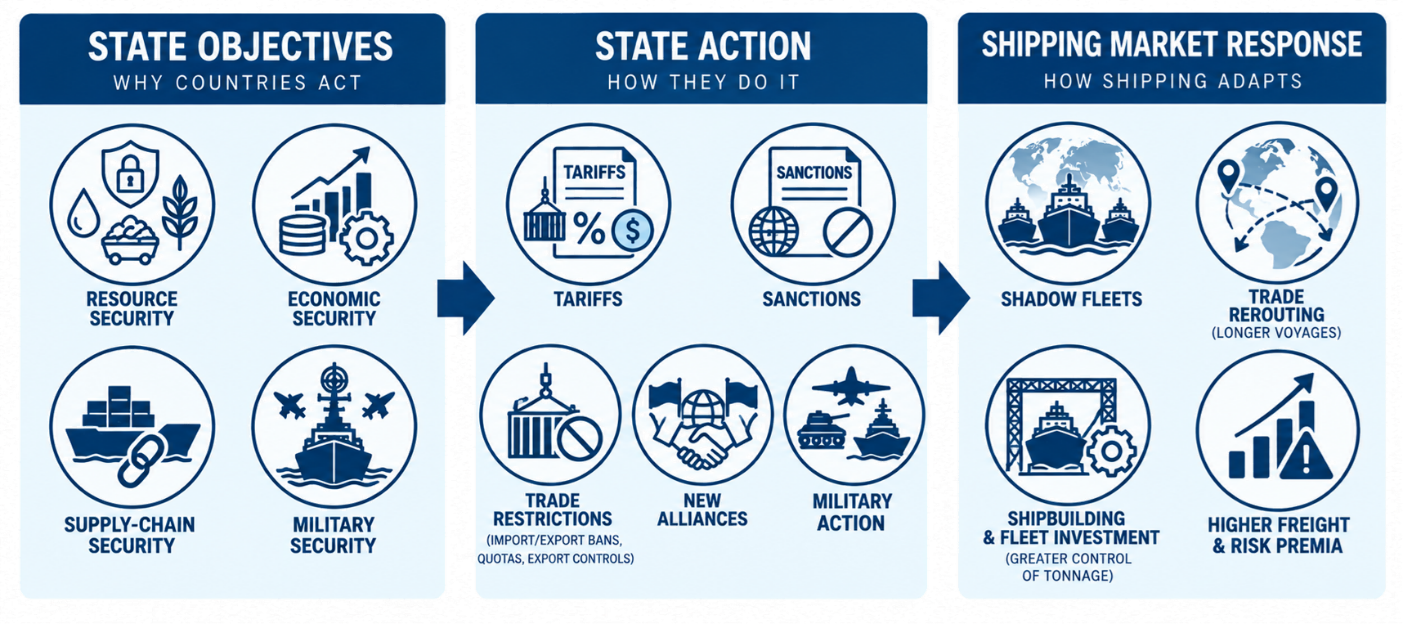
Russia’s invasion of Ukraine in 2022 kick-started a new wave of aggressive economic geopolitical interventions. This included the tightening of Western sanctions on Russian trade, Western commodity import restrictions and tariffs targeting importers of Russian crude – all aimed at cutting the financial lifeline to Russia’s war machine. The use of these trade restrictions proliferated once Messrs Trump and Netanyahu decided to crush Iran’s nuclear ambitions once and for all.
As trade restrictions bit, import bans on Russian commodities lengthened supply routes for LNG, LPG and oil; sanctions extended the lives of older ships while introducing new environmental and safety risks. And when Mr Trump took the reins at the White House last year, US-China rivalry intensified. China’s investment in ports and trade infrastructure, its burgeoning navy, and its access to rare earth deposits posed specific threats to US economic and military supremacy. The rapid expansion of China’s shipbuilding industry has been a particular US bugbear.
US hunger for natural resources, Mr. Trump’s ‘America First’ transactionalisation of US foreign policy, and the on-shoring of industrial production have upended trade and security alliances between the US and almost all of its post-WW2 trade partners. As a result, energy, food and military security are key priorities for governments across the world.
‘Hard’ geopolitics and chokepoints
It is, however, the recent proliferation of military conflicts that has the most direct geopolitical impact on shipping.
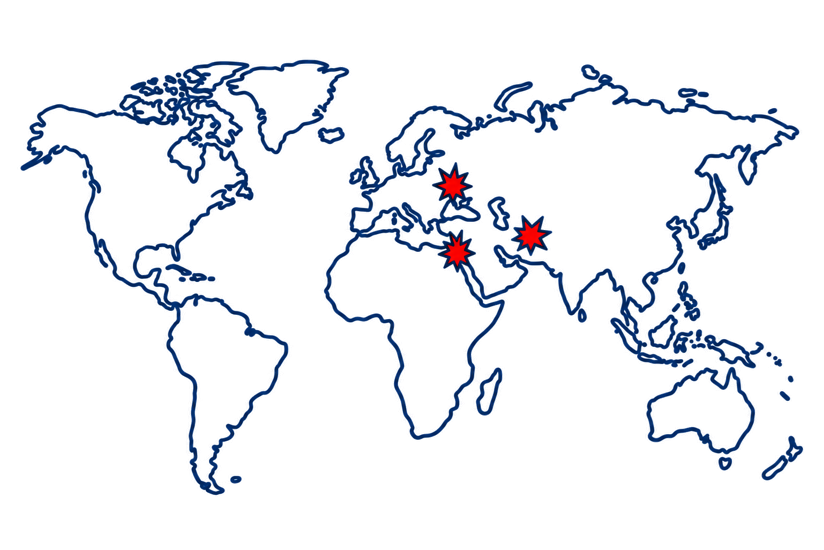
Russia’s war with Ukraine, now well into its 5th year, has rerouted Russian oil and gas exports away from Europe, disrupted Black Sea grain and oil exports, spawned a shadow fleet of ships, and more recently removed Russian refined products from the international market.
Israel’s conflict with Gaza and Lebanon (and later with Iran) that started in 2023 provoked Yemen’s Houthi rebels to attack ships passing Bab el-Mandeb at the southern exit of the Red Sea. Avoiding the Red Sea has increased voyage distances for all shipping sectors, sheltering containerships from tonnage oversupply, increasing bunker demand, and boosting tanker rates.
The US / Israeli war with Iran since February 2026 has shut in Iranian crude supply and reduced the flow of Mideast Gulf oil exports by around 13m b/d, lifting global prices for crude oil, refined products and LNG. LNG prices have tripled since the war. Brent crude hit $109/bbl last week. Diesel is currently over $200/bbl. Oil inventories have fallen around 507m bbls - about 2.8m b/d - since the war started. Oil and gas demand has been cut by 2.4-2.8m b/d. Ships - particularly tankers - have been trapped in the Mideast Gulf for extended periods. Replacement oil and gas has been brought in from further afield. And during the process, laws that once governed international trade have been torn up as choke points are either being taxed or otherwise obstructed.
The structure of ship ownership itself is changing as exporters struggle to find ships to lift their goods. Tankers are being bought at record prices as ‘strategic’ assets. Most importantly freight has become significantly less price elastic as Mideast producers discount crude to cover freight and importers rush to source alternative supplies.
Tanker freight markets
Tanker freight markets have broken all records in recent weeks. Last week the cost to move a VLCC from Brazil to China was $47.5m, up from $35.5m a week earlier. Freight for an Oman/China VLCC stands at over $40m, up from $28m last Monday. Cargoes loading inside the Mideast Gulf to China stand at about $78.4m (including AWRP of around $11m-12m).
Nor is this just affecting the spot market. An oil trader paid $100,000/day for a 3-year time charter on a VLCC last week, up from just over $58,000/day in May. Clearly there is confidence in some corners that strong spot market will be sustained. We assess a one-year time charter on a similar ship at around $200,000/day, which shows the extent to which strength is front loaded.
Is there a ceiling for tanker freight rates?
Freight rates can, theoretically, rise to the point where oil exporters have no financial incentive to export crude to the longest-haul destinations, or importers have no incentive to buy it from far afield. Before that can happen, the cost to ship a barrel of oil must be equalised across tanker sizes; steaming speeds must be maximised and downtime cut to a minimum.
But well before that happens, high crude freight costs are likely to push the delivered crude oil price to the point where refineries stop making money, thereby reducing their incentive to buy crude. Geopolitical factors have aligned to ensure that refineries in most of the world’s crude importing countries are making record profits, notwithstanding historically high delivered crude costs, and despite the destruction of demand for refined products. This is partly because we have lost around 5m b/d of global refinery runs - mostly in Russia (refinery production down 30%) and the Middle East (down 25%) due to Ukrainian attacks and Iran/Hormuz disruptions, respectively. This has freed up more crude for export, and forced refiners outside Russia, the Middle East and (for different reasons) China, to boost runs.
Crude price inflation has also been capped by ample crude stocks at the start of the conflict, particularly in China, and by the growth of crude supplies outside the Middle East.
Substitute crude supplies have arrived from the US (mostly SPR release) and other Atlantic basin producers. Overall, exports from outside the Middle East/Red Sea region have jumped 6% or 1.5m b/d since the closure of Hormuz. This has limited the need for cut demand.
The Americas can expect to continue to grow crude oil supply next year by about 0.8m b/d. However, since much of the ample global stock cushion that existed before the Iran war has now been absorbed, any continued loss of crude supply will now translate more quickly into higher crude prices. More importantly, governments - particularly those in developing countries - have thus far protected consumers from higher cost by cutting taxes. This was introduced as a short-term bridging measure only, and fuel costs are now having to rise.
An extended loss of Middle Eastern supply resulting from, say, the recent attacks on Saudi Arabia’s East/West pipeline, will continue to lift crude oil prices. This is likely to eat into refiners’ margins as any attempt to pass rising costs onto consumers will be resisted.
A rise in global refining margins resulting from a further loss of Russian refining capacity (Ukraine continues to pound Russian oil installations) without a drop in the feedstock price would also likely destroy demand. As demand destruction moves from voluntary cuts (for instance higher prices leading to less driving or flying) to forced cuts (government rationing) as stocks run low in crude importing countries like China, refined product exports are likely to be reduced to protect domestic product supply. The political cost of high pump prices could even result in the reduction in refined product exports from net crude exporters like the US. Any withdrawal of seaborne product exports would quickly have a negative impact on freight as global distillate prices spiral upwards and demand falls. If crude oil hits $120/bbl it would slow world GDP growth from last year’s 3.5% to 2%, says Capital Economics. On top of this, the recent rise in US interest rates will also slow demand growth.
Eventually, fleet growth will relieve some of the pressure on freight rates. But this will be a slow adjustment, even if the fleets of owners with higher risk appetite grow faster than the industry average.
Shipping charter markets
Today’s geopolitical drivers do not affect all shipping sectors equally. This is partly because different sectors entered the period of peak geopolitical disruption at different points in their market cycles. Mostly though, it relates to the exposure of exports to conflict regions.
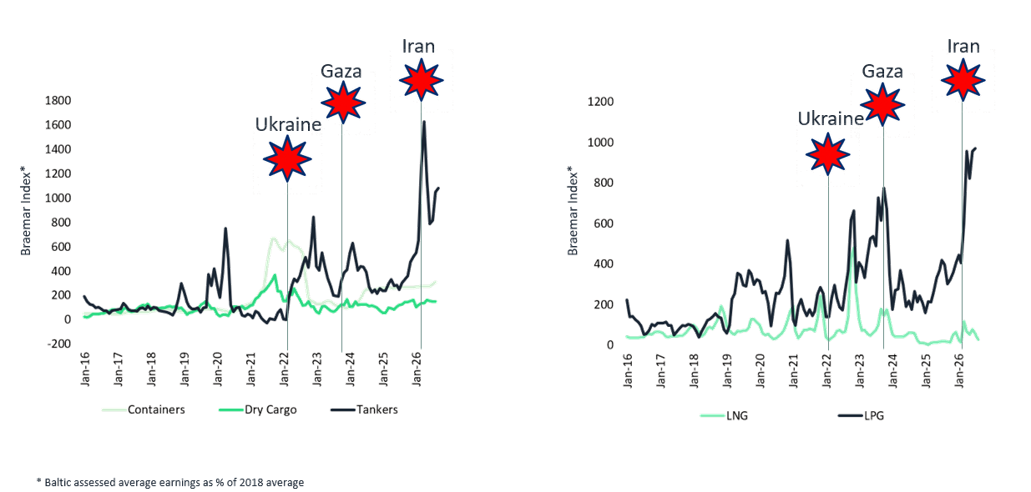
Containership rates are well down from the Covid-era strength, but despite weak demand growth and heavy flow of new ships into the market, rates have help up remarkably well.
Containership markets have escaped oversupply largely thanks to the greater distances travelled to avoid the Suez Canal. Trump’s tariffs have hit the all-important Chinese exports to the US, but imports of Chinese goods have rebounded elsewhere, allowing global containerised trade to grow by around 4.5% this year, we expect.
Dry bulk markets have seen some uplift from longer voyages to avoid the Red Sea. Other isolated dry bulk trades have been impacted by tariffs, such as US soybeans exports to China in 2025, but in this case volumes were replaced from South America with minimal impact on tonne-mile demand.
Unlike oil and gas, coal and iron ore deposits are located away from conflict zones. Coal deposits are centred on Indonesia, Australia, South Africa, the US, Colombia and Canada. Iron ore is mainly found in Australia and Brazil. Grain comes from Brazil, the US, Canada, Argentina, Australia, Europe, as well as the Black Sea.
Dry bulk rates have not yet returned to the highs witnessed during the Covid era of heavy port congestion, but they continue to be well supported by fundamentals, particularly those of the largest ships.
LNG charter rates have seen intense volatility as a direct result of the loss of exports from Russia, Qatar and the UAE. LNG rates spiked after Russia invaded Ukraine and Europe rushed to meet winter demand with US product. LNG carriers trapped in the Mideast Gulf when Iran closed the Strait of Hormuz boosted rates again earlier this year. But high gas prices have since slowed global demand growth. With US exports currently heading short-haul to the highest payers in Europe, longer-haul trade to Asia has taken a back seat. The reletting of underutilised Qatari LNG vessels back into the market has aggravated the rate weakness that has prevailed since July.
It is the LPG and large tanker sectors that are the biggest beneficiaries of today’s turbocharged geopolitical climate.
The loss of all important Mideast Gulf LPG exports after Iran closed Hormuz allowed US exports to fill the void. For the important LPG markets in Asia, the US is a more distant supplier than the Middle East. Additionally, Panama Canal congestion has tied ships up for longer on this route.
Since the start of the war in Ukraine, tankers have been the main target of economic sanctions. Tanker markets were initially lifted by the mid-sized Aframaxes and Suezmaxes when Russian crude oil was diverted from Europe to India and China. Likewise, clean product markets benefitted from longer-haul Russian diesel exports to Africa, the Middle East and Latin America. Sanctions quickly targeted tankers handling Russian exports. A renewed boost to tonne miles arrived when the Houthis pushed tankers out of the Red Sea in late 2023. The closure of the Hormuz Strait earlier this year forced importers to compete for longer-haul replacement crude barrels from the Atlantic and forced Middle Eastern exporters to offer attractive freight pricing to deliver exports to refiners.
Tanker supply
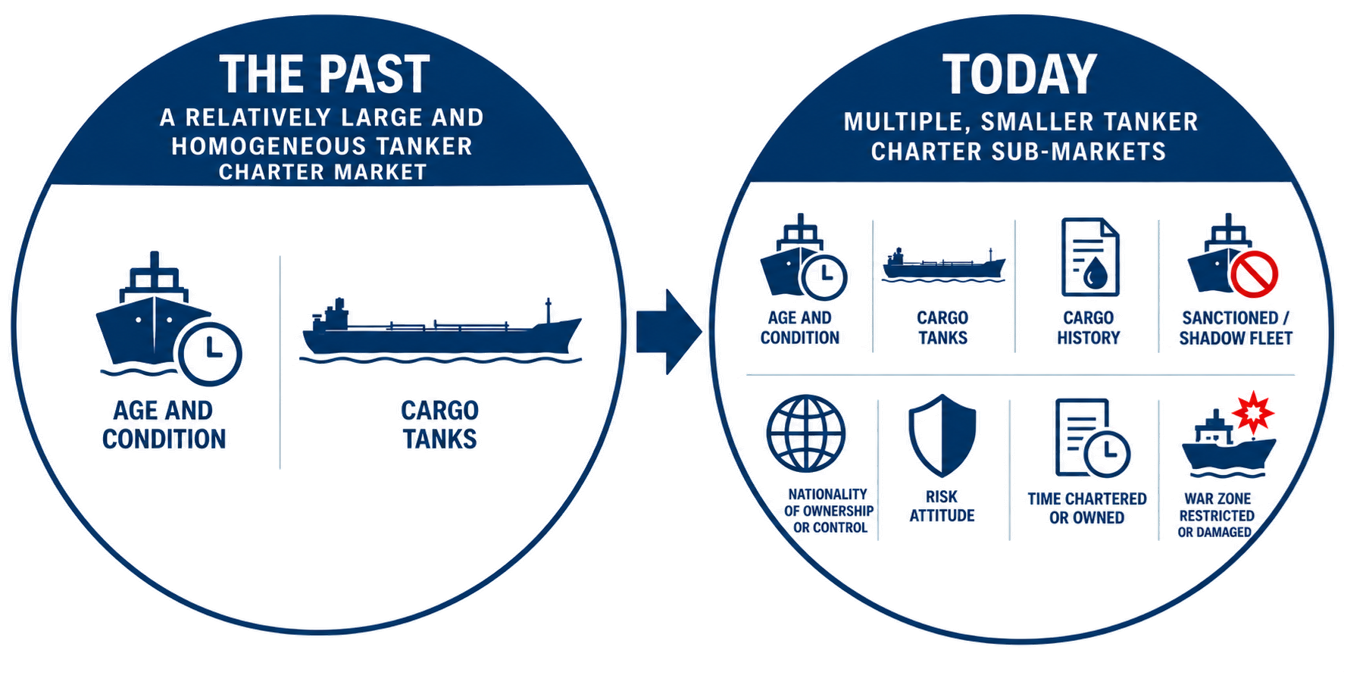
An under-reported support for the strength in today’s tanker freight markets is how geopolitics has turned a relatively large and homogenous tanker charter market into multiple smaller sub-markets.
Different oil importers, exporters and traders work with different pools of tonnage. Sanctioned ships are now off limits to most, but not all; vessels with a history of shadow cargoes are black-listed by many. Vessels on period charter or controlled by risk averse operators will typically not load in war zones. Even the nationality of the vessel’s owner in October 2025 threatened to define where it could trade, under rules adopted (and then quickly abandoned) by the US and China.
While strong rates have relaxed most charterers upper age limits over the past 5 years, the smaller the pool of ships available to charterers, the less pricing power the charter has. A charterer’s pricing power is even weaker when these pools of available ships are controlled by just a few owners, as Mideast exporters have discovered since the Iran war with the likes of Sinokor dominating the market.
Geopolitics is also shrinking the size of some fleets. At one point up to 50 non-sanctioned VLCCs were trapped in the Mideast Gulf. Several of those that have lifted Mideast Gulf or Red Sea cargoes and run the gauntlet via Hormuz or Bab Al Mandeb have been damaged by missiles or mines.
In recent days, the tit-for-tat targeting of tankers by the US and Iran has become more frequent. Some of these damaged vessels can expect to be out of the market for some time, possibly for good.
Tanker demand
On the demand side, geopolitics has first and foremost reduced the volume of oil moved around the world.
Since the start of the Iran war, the volume of oil and products lifted by tankers has dropped 12% (q2 2026 vs. q2 2025) and 26% for Mideast-dependant VLCCs. The losses were focussed on crude oil and refined product produced in the Middle East, but refined product exports fell in Asia too as the region conserved supply. The longer-haul nature of cargoes that replaced lost Mideast barrels has offered some protection to tanker demand. For instance, while VLCC liftings have fallen nearly 30% since the war, the amount of oil carried on VLCCs each day has continued its pre-war upward trend.
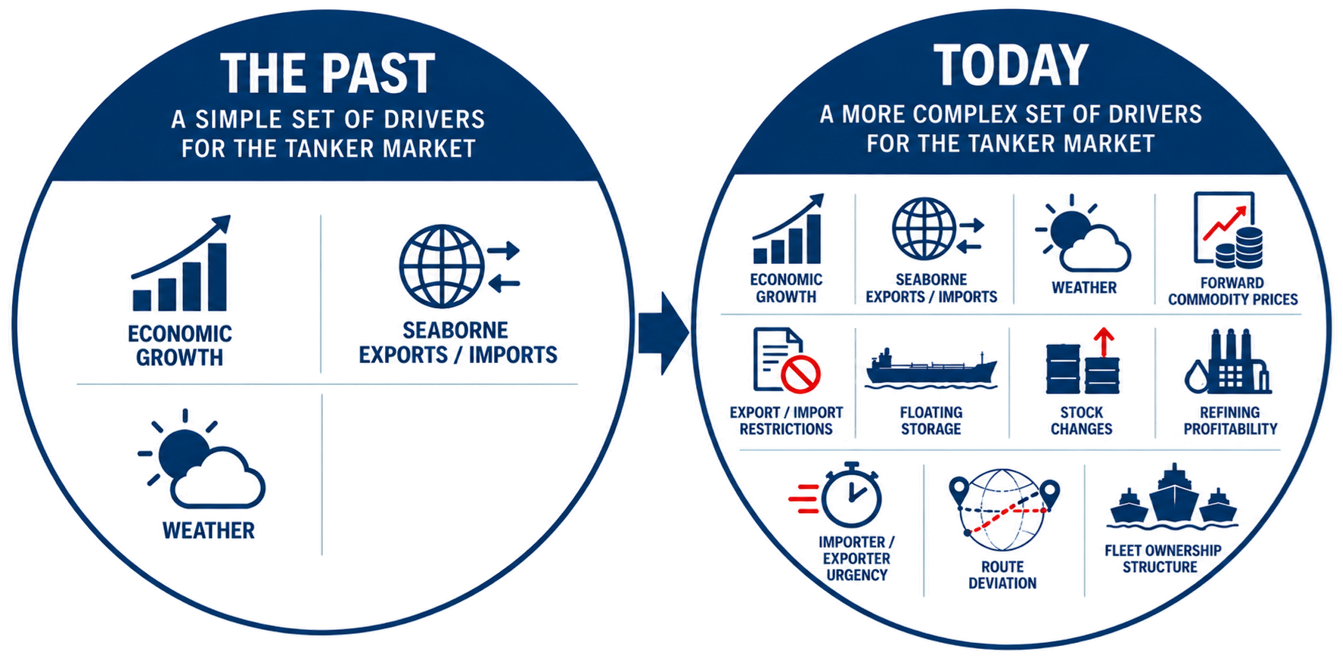
Geopolitics has also reduced the efficiency of the tanker fleet
Geopolitics has introduced trading inefficiencies by catching ships out of position. An unexpected drop in exports from one region, replaced by exports from another, creates a short-lived shortage of ships that inflates rates. Owners might hope to anticipate these shortages, but politicians rarely telegraph their intentions in advance.
Moreover, cargo price inflation that stems from the loss of cargo supply in one region tends to trigger a supply response from other regions. US crude supply, for instance, leapt 1.6m b/d, or 40% between Feb 2026 and May 2026, supported by the release of crude from its strategic petroleum reserves. This effect favours certain tanker sizes over others, aggravating tanker capacity shortages. On top of this, the increasingly long-haul nature of tanker trades - with more oil loading in the Atlantic and discharging in Asia - means the Atlantic’s open tanker capacity can swing sharply from shortage to glut as vessels take longer to return from the East.
Tanker freight grows inelastic
Geopolitical events of the past 5 years have changed how charterers calculate freight.
Three factors are at play here.
1) High crude prices allow Mideast oil producers to bid aggressively for tanker capacity. If they cannot attract tonnage, they cannot sell their oil; and with shore storage at or near capacity production has to be cut.
2) Importers, particularly Asian importers that had come to rely heavily on Mideast crude oil, face similar choices at their refineries. With local stocks at operational minimums they either pay what they need to secure deliveries, or face even more costly shuttering of their facilities now that commercial stocks have been drawn down. As imports dry up, charterers will look to book ships further in advance, shrinking the natural supply of commercially free tonnage. We call this the ‘urgency premium’.
3) Refining margins are at record highs across much of the world outside China, giving refiners and traders greater incentive to import crude oil, and greater scope to absorb higher freight costs.
Tanker ownership structure
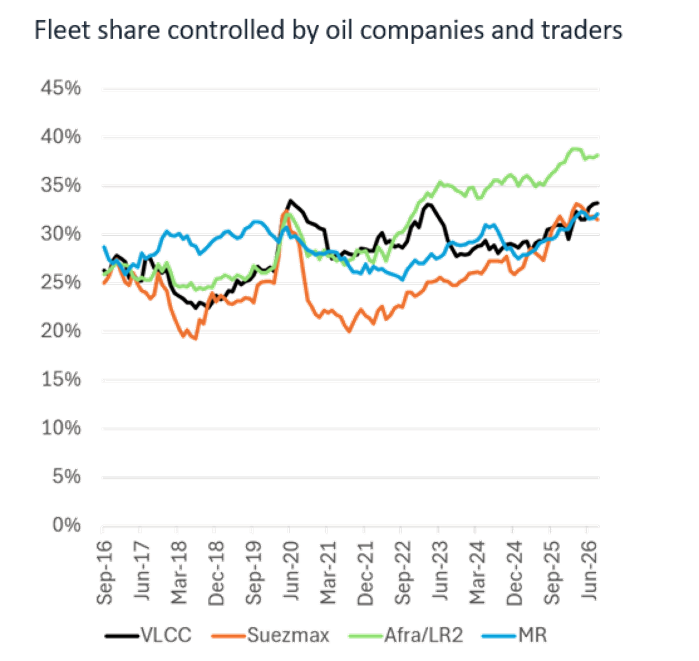
Inelasticity also stems from the expansion of tanker capacity controlled by charterers - notably oil companies and traders. As a company’s freight length increases relative to its oil length, it worries less about cheap freight. These traditional ‘charterers’ have grown their share of control of the Suezmaxes fleet from 20% to 35% since Russia invaded Ukraine. Their commercial control of Aframax/LR2 has grown from 27% to 38% and their share of MR control has grown from 25% to 35% of the fleet.
Shipping asset markets
Newbuilding prices remain heavily influenced by shipyard capacity and construction costs, whereas second hand values are responding much more rapidly to current freight markets and the value of having a ship available immediately.
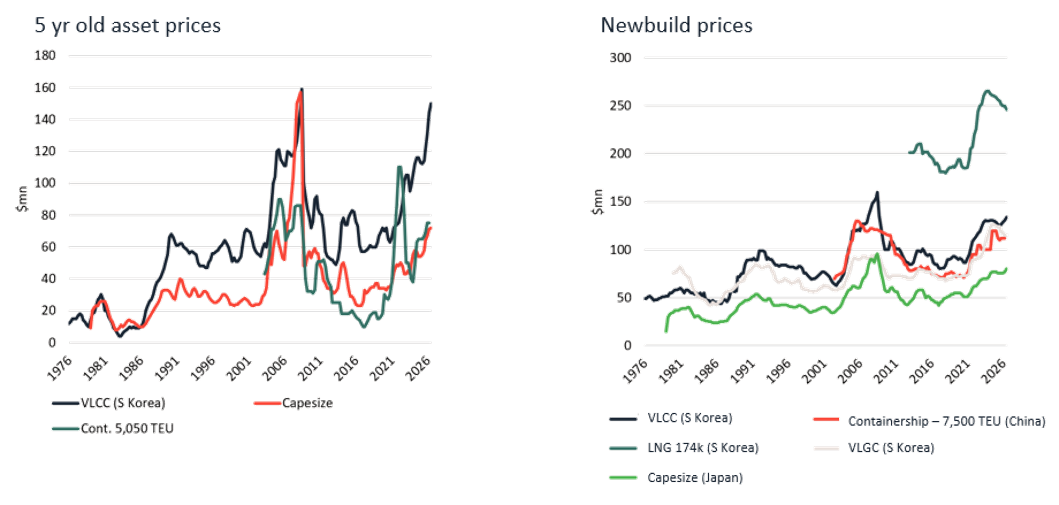
Across all shipping sectors, both newbuilding and second-hand prices are close to historical highs.
Container and VLGC (LPG) newbuilding prices have eased a little since peaking earlier this year, but dry bulk and tanker newbuild prices continue to rise.
In the second-hand market dry bulk and containership prices are rising fast. Dry bulk prices are still shy of their peak achieved in 2008.
Containership values exceeded their ‘Commodity Super-cycle’ peak during the Covid pandemic and have yet to recover to these levels despite rising fast since the start of Red Sea diversions.
The rise in tanker second hand values, and specifically those of the largest tankers, has been the most remarkable. VLCC second-hand values are now running well ahead of newbuilding prices. We assess a VLCC newbuilding $132m in South Korea and $126m in China. A newbuilding resale with prompt delivery recently sold for $200m; another delivering in October fetched $169m. Vessel age has remarkably little bearing on prices today; what matters is how quickly a ship can be delivered to its new owner. In recent weeks a 17-yr old VLCC fetched an $112m, up from around $27m before the war in Ukraine and $42m before the Iran conflict. A 9-year-old VLCC recently fetched $135m.
Shortly before the Iran war in addition to buying interest from established owners and investment funds, South Korean owner Sinokor inflated VLCC prices by embarking on an aggressive acquisition spree. As the cost and risk of moving ships in and out of the Mideast Gulf increases, Middle Eastern exporters have begun to view tankers as strategic assets rather than something that can always be sourced cheaply from the charter market. ADNOC continues to be a major buyer of VLCCs, while Iraq's SOMO has reportedly also been an active buyer.
Fundamentals still matter in the long run
Fundamentals still matter, but geopolitics are changing the way we view the traditional drivers of freight. For tankers and LNG carriers, today’s geopolitical backdrop has lowered our outlook for headline cargo volumes through slower economic growth, tariffs and localisation. But for tankers it has generally had a positive impact on shipping tonne-mile demand through diversification of sourcing; stockbuilding; longer voyages; route disruption and lower vessel productivity.
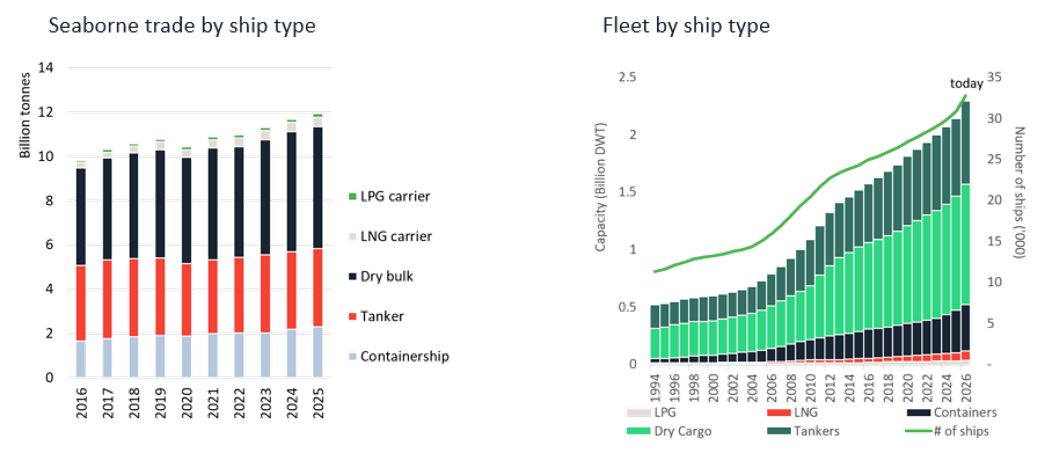
With big profits comes big investment in new ships
Thanks to stellar profits in the charter markets, the orderbook for all ship types apart from LNG has grown rapidly over the past 12 months. Dry cargo and tanker ordering has been focused on the largest size segments, the Capesize and VLCC.
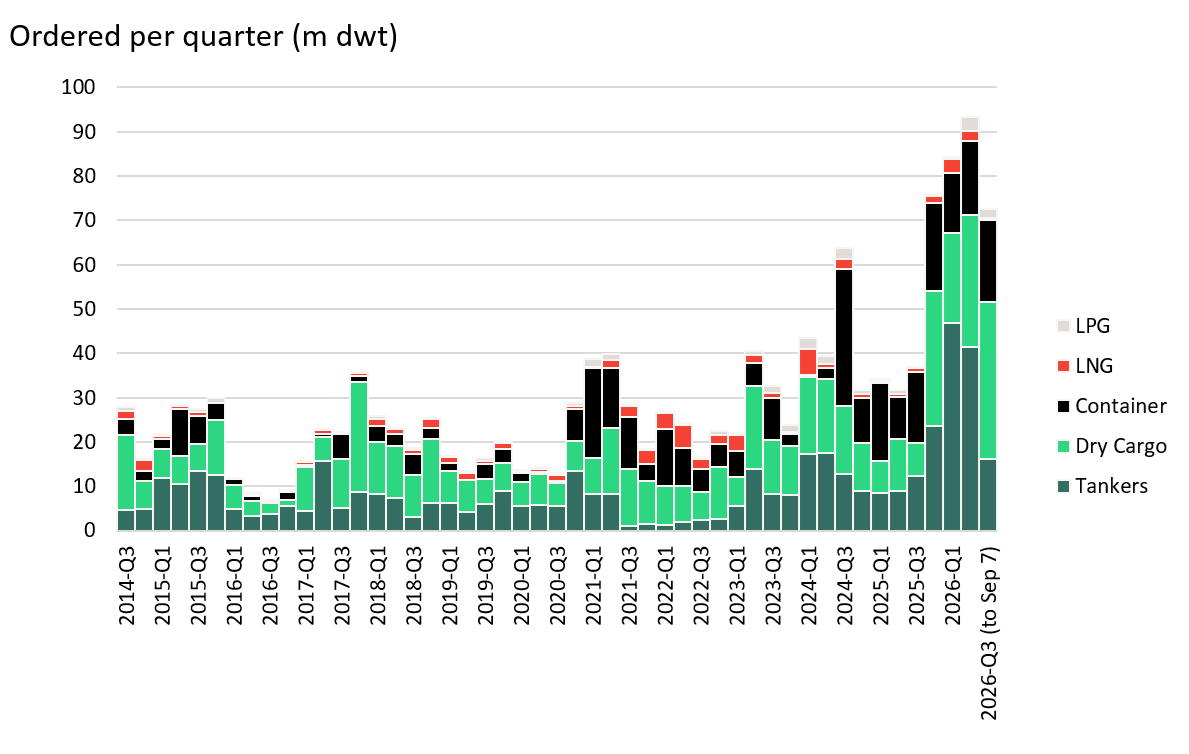
The tanker orderbook has grown from a low of 4% of the existing fleet in 2023 to 27% today. Recent tanker ordering has focused on the VLCC and Suezmax sectors, allowed their orderbooks to reach 37% and 32% of their respective fleets. This compares to an orderbook representing 18% of the fleet for MRs, 22% for Aframax/LR2 and 14% for Panamax/LR1. The comparison between large and smaller tanker orderbooks disguises the fact that heavy deliveries for coated tankers has been underway for well over a year, whereas VLCCs and Suezmaxes have only felt the weight of deliveries this year.
The tanker orderbook is heavy compared to bulk carriers, but light compared to other sectors of the shipping industry. The dry bulk orderbook was 11% in 2025 and has now reached 17% of the fleet. The container orderbook was just 18% of the existing fleet as recently as 2024, and now represents 40% of the fleet. The LNG orderbook was already heavy in 2024 at 51% of the fleet. A large number of new LNG carrier deliveries in recent years has dropped the order book to 40% of the existing fleet today. The LPG order book represented just 11% of the existing fleet in 2020. Today it has grown to represent 43% of the existing fleet.
Forecasters for energy prices have largely given up forecasting geopolitical events. Freight is bent and flexed by those same winds. But at one fifth of the value of Atlantic Basin crude and two fifths of the value of inside Mideast Gulf crude delivered to Asia - it has become one of the key variables for crude pricing. As Saudi Arabia is squeezed by both Iran and the Houthis, freight prices will continue to push upward.
We see no quick end to the three big conflicts impacting tanker freight. If anything, we fear new conflicts - military or otherwise - will layer more maritime inefficiencies on top of today’s disruption. Therefore, we have lifted our forecast for both 2027, and 2028 for VLCCs and Suezmaxes. This would allow for a modest reduction in oil demand in poorer countries as continued disruption takes effect.
We view Iran as having a keen interest to exert maximum pressure on the US before bypass pipelines planned over the next few years reduce its leverage over oil flows. Iran’s decision making is now heavily influenced by the hardline IRGC - who we would argue prioritise their own political legitimacy over their country’s financial health.
For his part, Mr Trump seems likely to maintain maximum pressure on Iran, irrespective of the impact of this policy on oil prices. Any restraint that his policy advisors might be urging him to show in the run up to the midterm elections will have vanished once they are over - no matter the outcome.
We see the tit-for-tat attacks on tankers in Mideast Gulf and Red Sea removing tonnage faster than our previous estimates for ‘capacity lost to the ageing process’
It is not so much a question of if and when we see the market returning to pre-Covid ‘norms’. We have to take into consideration the investment decisions being made in response to today’s geopolitical events. Some - like investment in pipelines, storage infrastructure, refineries and of course new vessels - have long-term implications for freight.
As of today we feel that the paper markets have caught up with our ‘bullish freight’ view. However, the rise in benchmark TD3c route has perhaps more to do with the lack of liquidity as players wait for TD34 to start up later this month, and more significantly, a lack of natural hedgers.
But a ‘deal’ on one of the major zones of conflict would change our outlook. From there on it would be a question of how quickly older, less efficient tonnage can, and will, exit the market.