
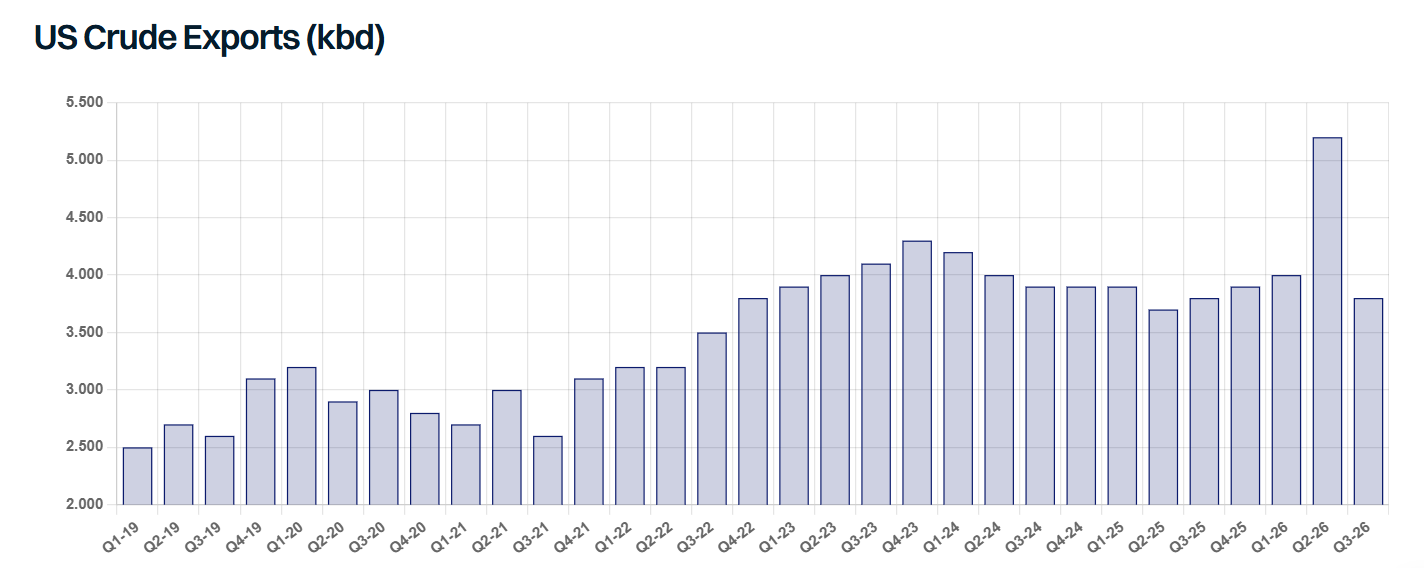
US crude exports have grown strongly in recent years, making the US a key source of global crude supply. This raises the question of how much export capacity the US actually has. According to Kpler data, exports peaked at around 5.2 mbd in Q2, when releases from the US SPR lifted volumes by close to 1.3 mbd, or more than 30%, on the previous quarter. This shows both the scale of implied US export capacity and how flexibly it responds to market conditions.
The surge was short-lived, however. Q3 volumes have retraced by around 1.5 mbd to approximately 3.7 mbd, back towards longer-term averages. Strong domestic refinery runs have absorbed barrels that might otherwise have been exported, as refiners chase exceptionally firm product margins.
Delayed maintenance, particularly among PADD 3 refiners, has also kept domestic crude demand strong. Even so, the Q2 spike shows what the US can achieve when export economics and supply align. It also highlights the spare capacity that exists when volumes recalibrate towards longer-term averages.
An important question for the tanker market is whether proposed VLCC-focused infrastructure will go ahead and raise this capacity further. At present, this looks uncertain: of the four proposed deepwater terminals, only Sentinel Midstream’s Texas GulfLink is progressing. It was licensed in February 2026 and construction began in May, with funding under the US-Japan Trade Agreement helping to advance development.
The terminal is targeting a start-up in Q4 2028. Enterprise’s SPOT was licensed in 2024 but still lacks a positive FID and appears to have stalled, with no fresh guidance on timelines. Energy Transfer’s Blue Marlin remains unlicensed as the company shifts its focus to upstream investment, particularly in natural gas. Phillips 66 and Trafigura’s Bluewater Texas is also unlicensed and faces EPA air permit issues.
As a result, US VLCC exports will remain reliant on reverse lightering for at least the next two years. The VLCC share of PADD 3 crude exports rose to around 50% in May and June, fell below 30% in August and recovered to around 45% in September, while Aframaxes continue to carry a substantial share of exports. This reliance on lightering can limit VLCC export capacity when crude exports trend higher, as Aframax availability and ship-to-ship logistics become a bottleneck.
Project cost inflation has also become a central issue for US energy export projects. Rising labour, construction material and legal/regulatory costs could all erode project economics and commercial viability, making this an important theme to monitor. If these pressures prevent new VLCC terminals in PADD 3 from coming online, longer-term US crude exports could suffer. This has clear implications for marketing US crude into Asia, where longer-haul trade fundamentals favour VLCCs over smaller tonnage.
This matters because, with demand in advanced Western economies on a downward trajectory, surplus US barrels will increasingly look East. That will put more focus on moving crude efficiently on VLCCs, especially as competition from Latin American producers into Asia grows.
The lack of progress on most proposed USG deepwater terminals could therefore become a constraint. Existing infrastructure has shown it can handle higher export volumes for short periods, but further growth in long-haul exports will increasingly depend on direct VLCC-loading capacity in order to optimise freight economics. Texas GulfLink is a positive step, but with the wider project pipeline still uncertain, US export infrastructure may struggle to optimise with the shift in crude trade towards Asia.
Data source: Gibson Shipbrokers