
The Big Picture: Red Sea reopening
Bearish for tankers, but impact uneven across tanker classes
By Mary Melton
As owners tests the Houthis’ resolve not to attack ships moving through the Red Sea, the negative impact on tanker demand of shorter voyages through the Suez Canal is back in the spotlight.
The Houthis announced their intention to halt their attacks last month. Laden tankers have been steadily returning to the Suez Canal since the start of this year, but this change could mark the return of the remaining Canal-avoiders.
The volume of oil moved through the Suez Canal has jumped 46% since January and is now (basis flows discharging in November) just 17% shy of its 2019 average. Dirty oil (crude + fuel oil) moving through the Canal is already back to 2019 levels thanks to high Russian exports in recent months. But it remains well below peak flows seen in H1 2023 while Europe barred Russian oil and the Red Sea granted safe passage. Clean volumes are still some 30% off their 2019 levels, and well below 2023 levels as Russia’s war with Ukraine lifted flows between the Atlantic and the refiners and consumers East of Suez.
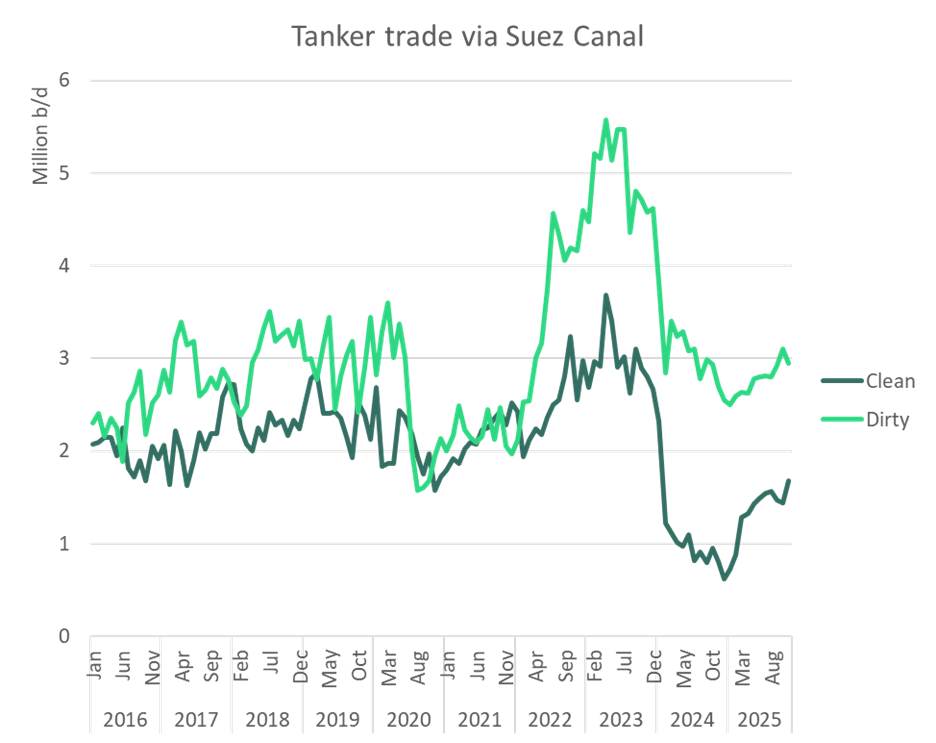
A full return to 2019 levels of Canal transit and the resulting loss of long deviations via the Cape of Good Hope appears to hinge on maintaining today’s fragile ceasefire between Palestine and Israel. A return to peak 2023 levels depends on how hard the US pushes Putin on Ukraine, and how quickly Russian oil returns to Europe. Before we look at what could happen, we must understand wider changes in trade between the East and Atlantic due to the war, the Red Sea closure and other structural changes.
Suez Canal flows since Russia’s invasion
We choose to focus on 2023 and 2024. We’re interested in the impact of Russian oil flowing East instead of to Europe, and what changed as Suez Canal traffic fell in 2024 but the European ban on Russian oil endured. We select 2024 as our baseline because Russia’s refined products and crude flows were operating as ‘normal’ – yet to be heavily disrupted by sanctions and the heavy level of drone strikes on refineries this year.
In 2023, before the Houthi attacks started, trade was already inefficient and tonne-mile demand was booming due to the Russian war. This period can be considered ‘peak’ Suez Canal transit period – Russian crude went East, while Europe required more Eastern barrels to replace lost Russian oil.
After the outbreak of the war, trade between the East and Atlantic increased by 1.02m b/d (9%) in 2023 compared to the period before Covid, when demand could last be considered ‘normal’. This included Russian crude and DPP going East (which quadrupled in volume) and Europe replacing Russian diesel.
East to Atlantic flows increased 12% when comparing 2019 to 2023. Apart from the war, this coincided with the opening of more refining capacity in the Middle East (approx. 2.1m b/d according to Platts) between 2019 and 2023, along with a 610k b/d loss in Europe’s capacity through 2022 (OECD). As these new refineries began to produce European-spec jet fuel and diesel and Europe sought a replacement for Russian diesel, the volume of middle distillates from the East to Atlantic increased by 344 k b/d (25%). This increased demand for LR2s at the expense of lost demand for Russia-origin MRs.
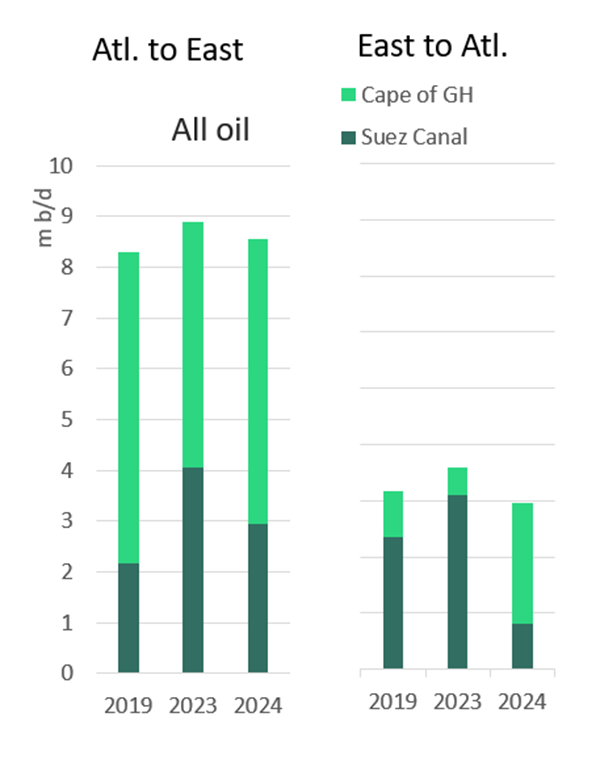
Although trade between the East and the Atlantic had increased by 9% because of the Russian war, it declined 8% yoy in 2024 with the Red Sea closure, wiping out most of the gains from the new trade routes. The reroute around the Cape of Good Hope was costly. A voyage from the Middle East-to-Europe around the Cape is about 15 days longer than one through the Suez Canal, raising freight costs.
Europe was heavily reliant on the Suez Canal for its imports and is keenly feeling the effects of the diversions, with 14% of its overall imports coming through the Canal before the Red Sea closure, and only 5% today. Voyage lengths for European imports increased by 15% with the Red Sea closure but were already up 22% because of the Russian war. All told, from 2019 (the last ‘normal year’ before Covid and subsequent geopolitical disruption) to 2024, the supply chain for European imports of crude oil and refined products is 40% longer.
Europe could not afford to diversify away too far from EoS middle distillates, imports of which only fell by 75k b/d (6%) yoy in 2024. Europe’s need for middle distillates plus the ongoing loss of Russian diesel increased transatlantic diesel flows, but the Middle East and India’s volumes were still vital. Virtually all these East to Atlantic volumes went around the Cape of Good Hope, which sent LR2 spot rates soaring in H1 of 2024. In the summer of 2024, we saw Suezmaxes and VLCCs cleaning up to carry middle distillate cargoes to the Atlantic, which saw LR2 liftings on the route decline by 20% in H2 of 2024.
Europe’s imports of Middle Eastern crude also suffered (partially also an effect of 2023 OPEC cuts). Middle East to Europe flows fell 415k b/d (37%) yoy. At the same time, volumes via the Cape increased by 533k b/d. The increase in share via the Cape favoured VLCCS at the expense of Suezmaxes due to the cheaper $/t cost of a larger parcel size on long-haul routes. In 2023, 80% of Middle East to Europe voyages were on Suezmaxes, but in 2024 this fell to 60% as VLCCs took away voyage share.
We expect to see trade between the East and Atlantic increase in the event of the Red Sea reopening due to the lower cost and shortened voyage, but the specifics depend on the Russia-Ukraine war. Here we explore the impact of the main scenarios, as we see them.
Scenario 1: Europe stays closed to Russian oil
In this scenario, the war and sanctions continue, but trade reverts to 2023 patterns (Russia exports going East, Europe importing middle distillates and crude from the East through the Suez Canal).
If Red Sea transits return in full force and the Russia war and sanctions continue, the most immediate impact we’d expect to see is an increase in Middle East to Europe crude flows, predominantly on Suezmaxes. This could be as many as 74 additional Suezmax liftings per year. This will likely dislodge some Americas crude and push it to the Asian market. Medium-sour Middle Eastern grades (like Iraq’s Basrah) are more desirable for Europe’s refineries than the lighter Americas crudes, because they yield more middle distillates – a perennial need in Europe.
Europe would import middle distillates from the Middle East and India in greater quantities due to the shortened voyage length and decrease exposure to the US Gulf market. This would hurt the Atlantic MR market and likely shift some of that demand onto LR2s out of the Middle East/India. This assumes most refineries in India (except for the Nayara refinery) refrain from buying Russian crude. The odd, discounted cargo from a non-sanctioned Russian supplier may be bought by the state-owned refineries for the domestic market, but most private refiners (like Reliance) would want to avoid Russian crude due to the upcoming European ban on CPP refined with Russian feedstock. Therefore, India’s middle distillates would be able to export to the European market. Additionally, with the fall in Russia’s diesel exports due to attacks on its refining infrastructure, Brazil is relying increasingly on the US for its diesel supply, which is another reason why Europe’s demand for Middle East/India middle distillates will likely increase.
Russian crude barrels would continue to head through the canal on their way East to the sanctioned Nayara refinery or the Chinese teapot refineries. We would expect to see virtually all Russian cargoes transit through the Suez Canal.
Scenario 2: Europe opens to Russian oil
The return of Urals to European refineries and diesel to Europe’s consumers could follow a phased or immediate removal of Western sanctions, once Russian refining infrastructure is repaired. With the Red Sea reopened, trade between the East and the Atlantic would continue at the elevated levels seen in 2023 until Russia fully reverts to its pre-war buyers (perhaps with the exception of piped oil).
Europe would still require middle distillates and crude from the East, but in reduced quantities. European refineries naturally prefer the medium-sour composition of Urals versus the lighter crudes of the Americas. Some upside for the tanker market exists in that Americas crude, which has comprised an increasing share of Europe’s crude imports over the past few years will likely be dislodged to the East.
Since the Russia war started, crude exports out of the Americas have increased 3m b/d. As Americas supply continues to increase, and if Middle Eastern and Russian grades can get more easily to the European market, increased supply from the Americas will likely be pushed East, offering a counter to the loss in tonne-miles engendered by a return of Russian short-haul trade. This should benefit VLCCs mostly but could also offset some of the negative impact to Aframaxes and to a lesser extent Suezmaxes, from the loss of Russia to East tonne-miles. VLCCs would be less likely to compete with Aframaxes and Suezmaxes on intra-Atlantic routes.
As is already happening, Brazil would rely on the US for the majority of its diesel imports. Transatlantic diesel trade would decrease, as Europe relies increasingly on Russian diesel and Middle East/India middle distillates. A return of Russian refining capacity would not happen overnight, and with Europe’s loss of refining capacity over the last five years, we would still expect to see a reliance on middle distillates from the Middle East/India. This demand would just be less than if Russia diesel was still shut out from the European market.
Regardless of the war’s outcome, a return in Suez Canal traffic is ultimately bearish for tanker tonne-miles, but the pain will not be shared evenly. Suezmaxes would benefit from the Red Sea reopening, as Middle East-Europe crude flows increase due to the shorter voyage and lower costs. VLCCs would no longer be preferred on the route, as they currently are for a voyage around the Cape of Good Hope, but they could benefit from more Americas barrels pushed East. For CPP, LR2s may be losing the tonne-miles generated by a longer voyage via the Cape, but Europe’s need for middle distillates from the Middle East and India should ensure imports remain high. Europe will likely no longer rely as heavily on US Gulf diesel from MRs if a shortened, more cost-efficient Middle East/India voyage is on the table.