

Focus has returned in recent days to the possibility of an end to the war between Russia and Ukraine, and what this could mean for tankers.
The detail of the latest iteration of the US-led peace initiative is likely to prove difficult for Russian to swallow. We should find out next week when Trump’s envoy Steve Witkoff visits Moscow. But this latest push for peace has been broadly welcomed as a solid step towards the opening of trade with Russia, and all that that entails.
The lengthening of supply chains provoked by the Russia/Ukraine war is popularly held to be a major reason for the strength in post-Covid tanker freight markets. It is tricky to isolate the impact of the reshuffling of oil flows post invasion, particularly since the Houthis also boosted average voyage distances in 2024, but we estimate that at its peak the war added some 6% for global dirty (crude + DPP) oil voyage length and 9% for CPP.
A Russia/Ukraine peace that returns Russian oil to its pre-war markets is therefore believed to be harmful for freight levels. This would be particularly true for Aframaxes that carry the majority of Russia’s war-time crude to India and China.
But a counterview maintains that returning Russia’s oil to Europe will support rates by shrinking the world tanker fleet. While the tanker fleet overall is currently well supplied, the younger ships that will be used to replace Russia’s war time flows are likely to remain in short supply - despite valiant efforts by the world’s shipbuilders over the next few years. This support for tanker freight, the argument follows, would outweigh any damage caused by lost tonne-miles.
That counterview deserves attention. It assumes that employment of crude older tankers has grown purely out of demand for shadow oil. Once export restrictions are removed, the market for these older tankers would quickly evaporate. Importantly, the same vessels would be barred from re-entering the ‘non-discounted’ oil market by the higher environmental, safety and compliance standards demanded by mainstream charterers.
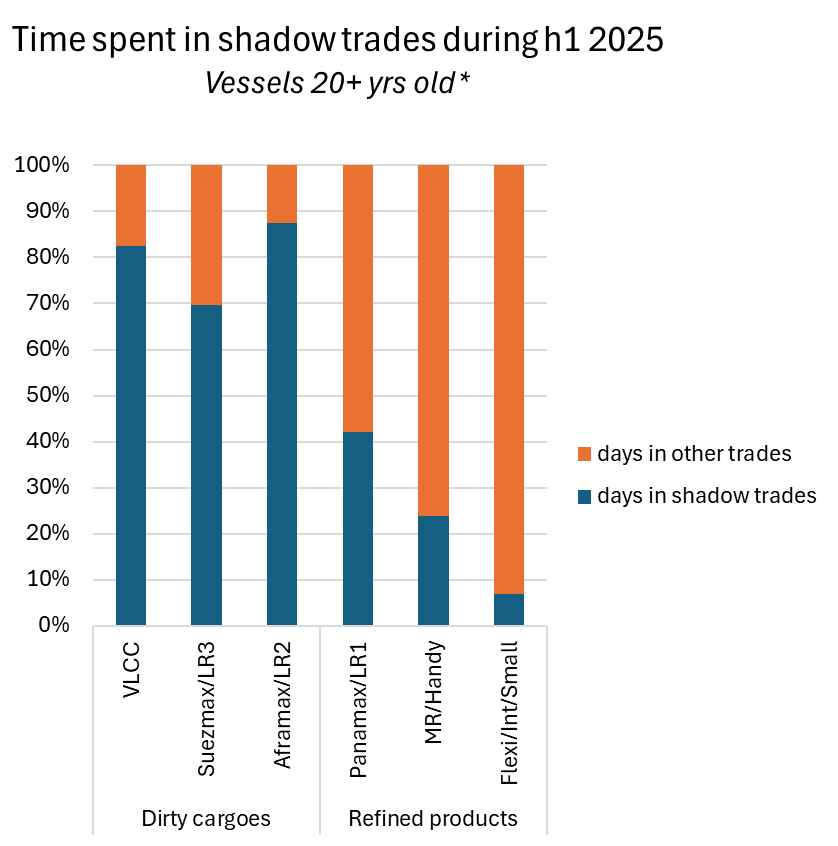
Shadow oil certainly dominates the employment of older crude carriers. Ninety percent of 20+ yr old VLCCs (in H1 2025) employment was in the sanctioned Venezuela and Iran crude trade. Three quarters of Suezmax trade, and over ninety percent of Aframax/LR2 crude trade came from shadow sources in H1 2025.
While war-time Russian flows added roughly 30% to average voyage length for the global dirty-trading Aframax/LR2 tankers, it did little to extend the average supply chain for Suezmaxes or VLCCs (which combined fell by 1%) .
Russian oil now employs roughly 16% of 19+ year old Suezmaxes and 23% of 19+ year old dirty trading Aframax/LR2 tankers. At any other time this century, these old tankers would have already been scrapped. The end of Russian aggression in Ukraine would therefore, on a net basis, support freights for those sectors.
But are these assumptions correct? Is it possible that the economic life of tankers has been extended not by the shadow trades themselves, but by the strong freight markets they have created? The fact that older tankers have ended up in shadow trades could be simply explained by the fact that they were paying more for them. Peace in Ukraine may merely cut the premium Russia is willing to pay for old ships. Instead of scrapping or sitting idle, mainstream charterers would begin to compete for these cheaper older ladies, rather than pay up for scarce modern units.
So, good or bad?
Our position remains that a market without sanctioned or discounted sources of oil will not allow crude tankers to trade beyond 20 years old. As such, peace in Ukraine should strip the majority of today’s 20+ year old Aframax and Suezmax units of their cargo base. Unknown ownership presents one of the key problems. Compliance desks in the mainstream market will not touch them.
To get round this problem mainstream owners could take them off their hands. But we think they would struggle to justify the investment required to get them back to the ‘Cap 1’ rating required for older ships in spot trades. Instead, free of sanctions, we would expect to see these older ladies heading gracefully for the beaches of India and Bangladesh.
The trouble is, when we last raised this view at our industry seminar in Dubai, several Indian owners told us that they would happily take older ships into Indian trades to keep a lid on their growing freight bill. Other East of Suez charterers will also probably tolerate cheaper, older units. The East represents most of the growth in oil imports that we expect to see over the next few years. Clearly if older tankers are prepared to discount the modern market, employment will be found in some corners.
But with the exception of India, most employment of older tankers will be intra-country, or at best intra-regional. We strongly doubt they will compete with modern units to move oil between regions, where most tonne-mile demand is generated. For inter-regional non-discounted oil trades, the continuing strong charterer preference for quality tonnage will limit max fixing age to 19 years in all but a few isolated cases.
Why? Because the risk of reputational damage from an oil spill from a tanker that is older than the industry standard max age would simply not be worth taking. Granted five years ago most blue-chip charterers applied the same logic to crude carriers over 15 years old. The shortage of under 15-year-old ships has since persuaded them to relax their vetting requirements. However, beyond 20 years old, owners will not have the confidence that they can guarantee the sort of trading profits to justify the high costs of 4th Special Survey to maintain ‘Cap 1’ compliance. The fact that scrap prices have tumbled around 43% since early 2022 has not helped vessels exit trading, but post-sanctions we maintain there would be little alternative left for 20 yr crude tankers.
Unfortunately (for their owners) the same cannot be said for smaller product tankers. In first half of 2025, Panamax/LR1s rely on shadow refined products (clean and dirty) for only 40% of their employment in product trades. For MR/Handy shadow employment makes up just 23% of all employment, and just 6% for smaller tankers. They would stand to lose around 9% of average voyage length post-war, with little compensation from the removal of superannuated vessels.