
This week’s Allied QuantumSea Research reviews January 2026 developments in the global grain trade, where outcomes were shaped primarily by Black Sea security and operating conditions rather than changes in agricultural supply or export infrastructure. Ukrainian grain exports continued via the maritime corridor, but shipment execution remained less regular than the prior-year period, reflecting elevated operational friction and risk-related costs rather than a loss of physical export capability. In parallel, U.S.-mediated talks involving Russia and Ukraine were held in Abu Dhabi in late January. No agreement or ceasefire was announced following the discussions, though the parties signalled willingness to continue engagement, with further talks anticipated in the near term.
Ukrainian Maritime Corridor: Operational Status in January
Official Ukrainian government statements in January confirm that the Ukrainian maritime export corridor remained operational throughout the month, supporting continued seaborne grain exports from Odesa-region ports.
As of 23–24 January 2026, Ukrainian authorities reported that since the corridor’s launch in 2023 a total of 160–168.9 million tonnes of cargo had been transported, including approximately 98–100 million tonnes of grain. Several thousand vessel transits have been recorded, predominantly involving bulk carriers.
These volumes indicate that port infrastructure and export capacity remain available, notwithstanding periodic disruption linked to security conditions and vessel availability.
Export Performance and Constraints in January
While the maritime corridor remained operational, Ukrainian agricultural representatives reported weaker export performance during December and January compared with earlier periods. This deterioration was attributed to cumulative disruptions affecting port operations, energy supply, and inland logistics, which reduced execution efficiency without undermining underlying export capacity.
Commentary from the Ukrainian Agri Council indicated that agricultural exports were materially lower year-on-year, pointing to operational constraints as a key factor shaping January shipment execution. From a shipping perspective, these conditions translated into irregular loading schedules, shorter forward visibility, and increasingly selective vessel participation.
These execution dynamics formed the immediate operating backdrop for Black Sea grain trade during the month, alongside continued Russian export activity from the region.
Russian Grain Exports and Compliance Context
Russia continued exporting grain at scale in January 2026 from established Black Sea ports under relatively stable logistics conditions. Food and agricultural exports are not subject to direct trade sanctions, allowing Russian grain shipments to continue into traditional importing regions.
At the same time, Ukrainian state authorities and intelligence services reiterated concerns regarding grain exports originating from occupied Ukrainian territories, including via ports such as Mariupol. According to Ukrainian officials, these reports describe efforts to integrate occupied ports into Russian logistics chains.
While such claims are intelligence-based and politically contested, they remain relevant from a compliance and counterparty-risk perspective, underlining the importance of careful cargo-origin verification by shipowners, charterers, and brokers operating in the region.
U.S.–Russia–Ukraine Negotiations: January Developments
U.S.-brokered diplomatic engagement involving Russia and Ukraine took place in Abu Dhabi in late January 2026. The discussions concluded without a ceasefire and without any announced agreement affecting maritime operations in the Black Sea.
From a shipping-market perspective, the relevance of these talks lies in their signalling effect rather than in any immediate operational change. In the absence of a maritime framework or evidence of de-escalation, insurance conditions and vessel deployment decisions continued to reflect prevailing Black Sea risk assessments.
Security and Insurance Environment in January
During January, Black Sea war-risk insurance conditions tightened following security incidents involving commercial shipping in the region. Market participants reported higher premiums and shorter review periods, contributing to increased cost uncertainty for voyages into the Black Sea.
Although the incidents referenced specific vessel types, the insurance response was applied more broadly across Black Sea shipping, including dry bulk and grain carriers. For grain movements, this environment was reflected in more cautious owner participation and a greater emphasis on contractual provisions addressing war risk, deviation rights, and operational contingencies.
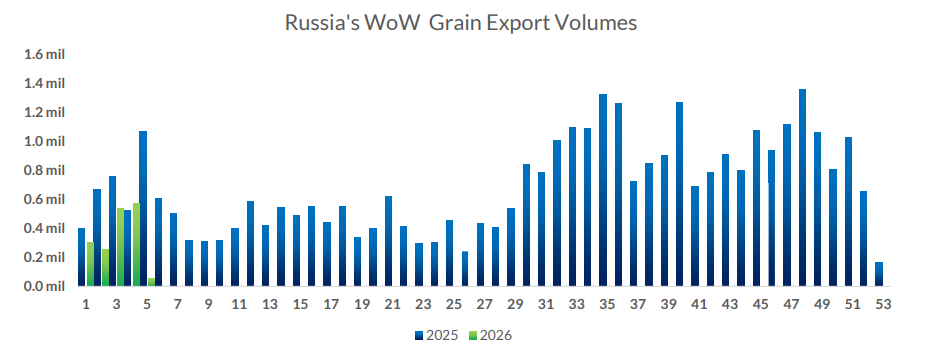
Weekly Export Volume Analysis (2025 vs 2026)
Based on weekly export tracking data comparing January 2026 with January 2025 provides quantitative validation of reduced export throughput.
Key data observations:
• Weeks 1–4 of 2026 total approximately 1.13 million tonnes, versus around 2.35 million tonnes in the same period of 2025
• This represents a near 50% year-on-year reduction, visible from week 1
• The strongest January 2026 week reached ~571,000 tonnes, below January 2025 peak weeks exceeding 750,000 tonnes and above 1.0 million tonnes
• No January 2026 week exceeded 600,000 tonnes
Looking Ahead: Market Context
The January conditions set the operating context for the next period. January 2026 did not signal a change in underlying conditions but rather the continuation of the framework for Black Sea grain trade. Market performance metrics for the period reflect how participants engaged in risk allocation, operational planning, and execution, not changes to export capacity or access. From a shipping perspective, grain movements remained feasible but uneven. Continuity and throughput were determined by operational resilience, insurance conditions, and contractual arrangements, suggesting that near-term performance continues to depend on execution conditions rather than structural limitations.
Data Source: Allied