

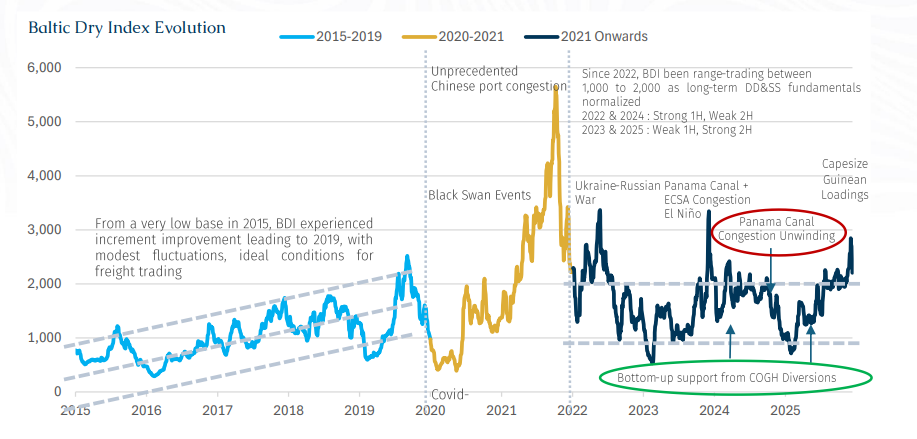
In recent years, the dry bulk market has experienced its fair share of swings, repeatedly testing market participants’ expectations of when freight rates might shift into a higher gear. Using the Baltic Dry Index as a proxy, the index has largely traded between 1,000 and 2,000 points from the second half of 2022 to date, as long term demand and supply fundamentals have normalized.
During the relatively brief episodes when the BDI breached the 2,000 point threshold, the upside momentum has typically proven short-lived, as illustrated by the recent surge to 2,845 on 3 December followed by a swift correction to 2,121 by 17 December. So, why is the BDI incapable of consolidating gains and pushing higher?
Following the post-Covid rebound of 2021-23, the growth in global dry bulk shipments measured in metric tons has moderated, with the slowdown becoming more pronounced heading into 2025. As a result, underlying dry bulk demand growth is now materially lagging projected fleet deliveries for 2025 and likely for 2026. This imbalance places an effective ceiling on the upside potential of freight rates, both in terms of magnitude and duration, despite on-and-off supply side efficiencies that have tightened effective tonnage availability and periodic surges in cargo loadings observed over recent years.
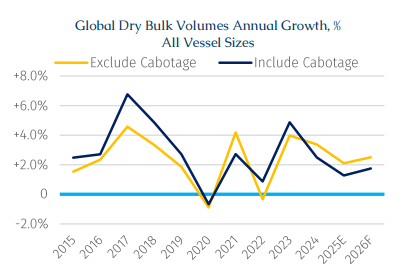
Heading into 2026, we expect global dry bulk trade growth to hover around the 2.5% level, extending the recent trend of plateauing expansion. Capesize loadings are likely to outperform, supported by increased cargo availability in the Atlantic basin.
In contrast, subcapes loadings may lag if global economies struggle to absorb the impact of US trade tariffs, with 2026 marking the first full year of their implementation. In this final issue of the year, we surveyed the demand landscape for dry bulk shipments across major geographical regions, commodity patterns and vessel segments to provide a comprehensive perspective.
Countries
China has and will continue to be the main engine driving bulk shipments, there is simply no other countries ready to step up in the foreseeable future.
Hence, dry bulk fortunes will be closely tied to how much China can still accommodate bulk arrivals in its port.
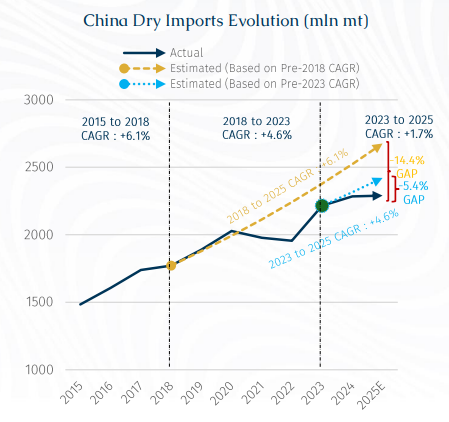
In recent times, China’s economy has matured. Its Fixed Asset Investment has shown a marked slowdown in 2025, even contracting in the latter part of the year, down 1.7% over January to October. This was largely driven by a pronounced downturn in the real estate sector, although high tech manufacturing and infrastructure investment continued to show pockets of growth.
This shift has translated into a gradual but persistent deceleration in China’s dry bulk import growth trajectory, with CAGR easing from 6.1% over 2015-2018 to just 1.7% per annum over the past two years. As a result, while China’s dry bulk imports have reached historic highs in absolute terms in 2025, volumes are clearly falling short of earlier growth expectations that underpinned shipowners’ newbuilding decisions at shipyards earlier this decade.
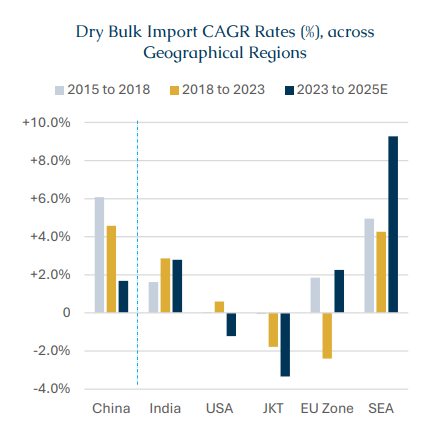
For context, China accounted for 40.8% of total dry bulk imports in 2024, while India, the US and other North Asian economies collectively represented just 21.8%, roughly half of China’s share. Meanwhile, India’s import growth over the past seven years has stagnated at less than 3.0% per annum, materially lower than China’s earlier CAGR of 4.6% over 2018 to 2023. More concerning is the evident deceleration across developed regions, including the US and JKT. In particular, JKT imports have slipped into structural contraction territory, registering a negative CAGR of 3.3% over 2023-25.
Although the EU has rebounded over the past two years, this recovery largely reflects a low base following weak import growth over 2018-23. Lastly, Southeast Asia led by Vietnam continues to expand, though the region remains too small to act as a decisive demand driver. Moreover, with US tariffs increasingly targeting these economies, a more uneven growth path is potentially ahead.
Commodities
Iron ore trade volumes continue to push higher this year, with a y-o-y growth of 2.4% (+37.7 mln mt) for January to November. Australian exports contributed an additional 13.2 mln mt while Brazil upped it with 16.6 mln mt gains, giving ore carriers firm support at the Pacific and Atlantic basin. On the import end, China drove bulk of the gains at +30.0 mln mt. As mentioned earlier, developed countries such as Japan and South Korea continue to dampen the growth brought by China and other countries.
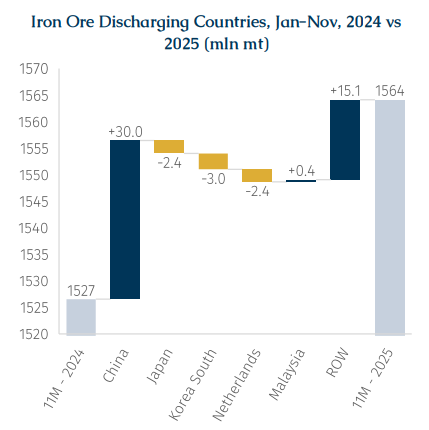
Over the past two years, a surge in Chinese steel exports pressured Japanese and Korean steelmakers, impacting their profitability and thus, raw material needs. Furthermore, Japan and South Korea are also heavily investing in Electric Arc Furnaces (EAFs) which use more scrap steel.
Coal trade volumes in 2025 dropped by 57.8 mln mt across January-November, representing a 4.6% annual contraction. The majority of this decline was driven by China, where imports fell by 60.8 mln mt. The sharp fall in domestic coal prices to four-year lows has reduced the attractiveness of imported coal, particularly given Indonesia’s efforts to raise coal prices by gaining greater control over HBA index-based pricing.
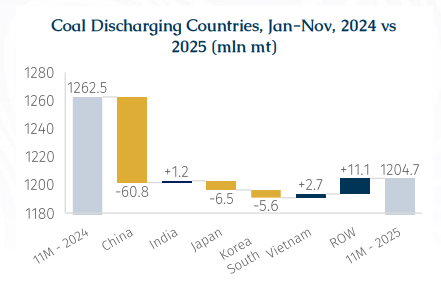
At the same time, Chinese utilities have increasingly prioritized long term offtake commitments with domestic miners against a wider backdrop of elevated stockpiles, faster adoption of renewable energy and softer industrial demand, particularly from energy intensive sectors such as cement. According to AXSMarine data, Chinese coal arrivals totaled 384 mln mt in 2023, peaked at 435 mln mt in 2024, and are expected to end 2025 at around 365 to 375 mln mt, below 2023 levels.
The contraction in Chinese coal imports has been further compounded by concurrent declines in Japan and South Korea, while miniscule increases from Vietnam, India and others have been insufficient to offset the broader weakness.
Grain (soybeans, corn, wheat etc) trade volumes have remained relatively subdued this year compared with recent peaks, declining by 3.5 mln mt over the first eleven months, equivalent to a 0.7% y-o-y contraction. As with coal, China accounted for the bulk of the weakness, with grain imports falling by 15.2 mln mt in 2025, while the shortfall was largely absorbed by the rest of the world.
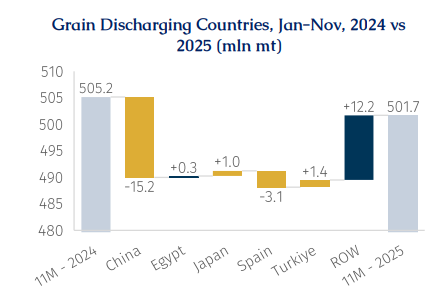
Recent market narratives have focused heavily on how much grain China can source from the US amid ongoing trade frictions. However, less attention has been paid to underlying Chinese end user demand. Since the first half of 2025, Chinese authorities have sought to rein in oversupply in the hog sector in response to persistently weak pork prices, which has directly constrained downstream feed demand. At the time of writing, pork prices are hovering around 12 CNY/kg, well below the peak of 37.8 CNY/kg recorded in September 2020.
After peaking at around 100 million mt in 2020, Chinese soybean imports have broadly plateaued. To date, increased Brazilian exports have largely come at the expense of US market share. This raises the more structural question of whether China can accommodate incremental volumes simultaneously from Brazil, driven by resource security considerations and BRICS alignment, and from the US, motivated by trade appeasement, given the different strategic objectives attached to each origin.
On the export side, the grain market has increasingly taken on a zero-sum dynamic. Major exporters such as Brazil, the US, Argentina, Canada and Australia have all expanded grain loadings, with combined gains led by Brazil at 11.2 mln mt, the US at 7.4 mln mt and Argentina at 10.8 mln mt. These gains have been offset by a collective decline of 41.8 million mt from other exporters, largely reflecting ongoing disruptions in the Black Sea region.
Capacity
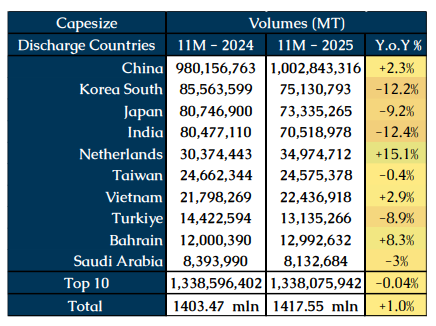
Overall, Capesizes in 2026 appear set to benefit from long haul iron ore and bauxite shipments from Brazil and Guinea, as reflected in the repricing of the C5TC Cal 26 FFA contract, which rebounded from a low of the mid $17,000/day range in June, when sentiment was overly pessimistic, to around $24,000/day currently. Moreover, while China has traditionally shouldered the bulk of Capesize demand, if Japan, South Korea, and India can potentially contribute, even in small increments, that would meaningfully strengthen the demand outlook.
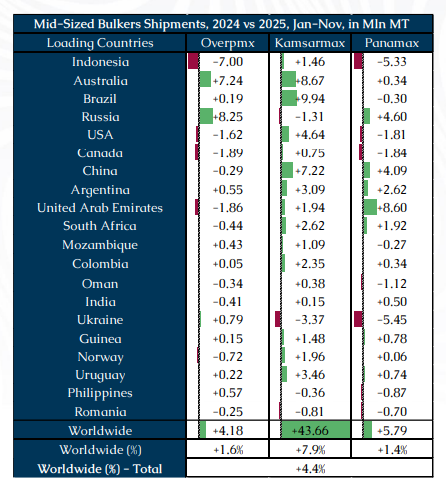
While Kamsarmax shipments have risen by 7.9% this year, this appears to reflect a shift in charterer preference toward this segment, rather than a genuine expansion in overall volumes, as older and smaller Panamax units recorded only a marginal increase of 1.4%. Collectively, the mid-sized segment (68-100K Dwt), record a 4.4% annual increment.
For geared bulkers, the annual increase stands at 2.6%, although the gains were highly uneven across segments. Ultramaxes rose sharply at 11.6%, while Supramaxes declined at 5.3%. In contrast, Handymaxes recorded a robust increase of 14.4% while Handysize volumes were broadly flat at 0.9%.
Overall, this divergence suggests that cargo flows are increasingly favouring the larger and more fuel-efficient geared units, rather than a broad-based recovery in subcapes bulker demand. This dynamic is further complicated by the inconsistent application of US trade tariffs in 2025, which have distorted trade flows while increasing uncertainty around cargo origination.