
It has been another year for the books in the tanker markets, with almost too many events to recap. We covered the first half of the year in our earlier report titled “All about US”. In this report we will limit our focus to recapping some of the key developments of the second half of the year. The latter half of the year certainly had its fair share of geopolitical turmoil, but for the tanker markets it will be remembered for the sky-high dirty freight rates achieved especially in Q4. Clean markets have been healthy, though nowhere near as strong, and weaker compared to a 2023 and 2024.
The war continues
The Ukraine war remained at the top of the agenda in the latter half of the year. On the 19th of July, the EU published its 18th sanctions package against Russia, sanctioning over 100 vessels and lowering the crude price cap from $60 to $47.6, curtailing access of mainstream tankers to Russian markets. It also announced a ban on EU imports of products refined from Russian oil beginning on the 21st of January, which was subsequently detailed further in the 19th package. Turkish refineries have since dialled down imports of Russian crude. India, also an exporter of products refined from Russian crude to the EU, saw Nayara Energy designated, which runs the Vadinar refinery.
India remained a political target and in August Trump imposed a 50% tariff to punish the country for its continued imports of Russian crude. A meeting between Putin and Trump also took place in August, in a fresh attempt to negotiate peace in Ukraine, though seemingly little progress was made. Russia’s crude exports to India remained largely resilient, and any drop was partially absorbed by China. In the meantime, Ukrainian drones continued to strike Russian energy infrastructure. Russian CPP exports from western terminals declined into Q4, with multiple refinery outages contributing, though increased seasonal domestic demand also played a role. Inversely, Russian crude exports from western terminals rose.
October saw the designation of Rosneft and Lukoil by OFAC, as well as the release of the 19th sanctions package by the EU, sanctioning Chinese refineries as well as a host of vessels. The former designation in particular caused havoc in the tanker markets, with multiple Chinese and Indian refineries seeking additional non-Russian supplies. Mainstream suppliers from the Middle East, Africa, US, and Latin America stepped in, boosting tonne miles and benefitting the larger crude tankers. With sanctions on Iran also intensifying and OPEC+ supply increasing, crude and DPP volumes on the water rose to levels not seen since the pandemic and crude tanker freight rates skyrocketed, particularly for VLCCs.
In December, another strong push for peace was made, and negotiations are still ongoing. Still, as before, the path to peace remains uncertain and it is unclear to what extent trading relationships can revert to pre-war patterns. The news also recently emerged that the G7 group of countries are considering removing the oil price cap, first implemented at the end of 2022. The removal of the cap would see a full and unconditional ban on G7/EU companies providing maritime services to support Russian oil trade, in effect pushing Russian business entirely to the shadow fleet.
Trump turmoil
Another overarching theme of the second half of the year was continued turmoil introduced by the Trump administration. After the United States Trade Representative (USTR) published their action plan to address alleged Chinese maritime dominance in April, few details emerged on the port fees until much closer to the implementation date. The port fee saga came to a head in October, when fees were imposed for making port calls in the US based on whether a vessel is Chinese built or Chinese owned or operated. China retaliated with little preamble by introducing their own, much more impactful port fees, massively restricting trade for any non-Chinese built ships with clear US links calling at Chinese ports. With VLCCs most impacted, the Chinese port fees tightened vessel supply, supporting freight rates. This situation was short lived, however, as a meeting between President Trump and President Xi in late October resulted in all port fees being paused for at least a year.
Elsewhere, the Trump administration’s maximum pressure campaign on Iran continued in the latter half of the year, with various OFAC sanctions implemented. Perhaps the most impactful was the designation of the Rizhao oil terminal, which accounts for around 10% of China’s total crude imports. This resulted in further volatility in freight rates, again most significantly affecting VLCCs.
Towards the end of the year, the US ratcheted up pressure on Venezuela, seizing a sanctioned VLCC and imposing a de facto embargo on the country’s oil exports. Venezuelan crude/DPP exports have averaged 900kbd in 2025, of which 140kbd went to the US, with most of the balance likely to have ended up in China or blended into the SE Asian market.
Decarbonisation delayed
This April, the IMO Net Zero Framework was established at the 83rd session of the International Maritime Organization’s (IMO) Marine Environment Protection Committee, also known as MEPC83. However, in October, after strong US opposition the final vote was delayed by twelve months. As a result, the industry is now facing an increased level of uncertainty – it is unlikely that the framework will be adopted in its current form next year.
Red Sea
The second half of the year saw an increase in clean and crude tanker trade through the Red Sea, though volumes remain significantly below 2023 levels. Consequently, LR2s especially have seen reduced demand in 2025, with clean cargoes on VLCCs and Suezmaxes continuing at varying levels throughout the year. A less substantial impact was felt on crude tankers, with other factors far more relevant.
This development came despite renewed Houthi attacks on commercial shipping in both July and September. The ceasefire deal between Hamas and Israel reached in October led to an official announcement by the Houthis in November to pause attacks on commercial shipping for as long as the ceasefire lasts. Since then, major shipping companies have announced their intention to trial a return to the Red Sea, potentially paving the way for a full normalisation of Red Sea and Suez Canal trade.
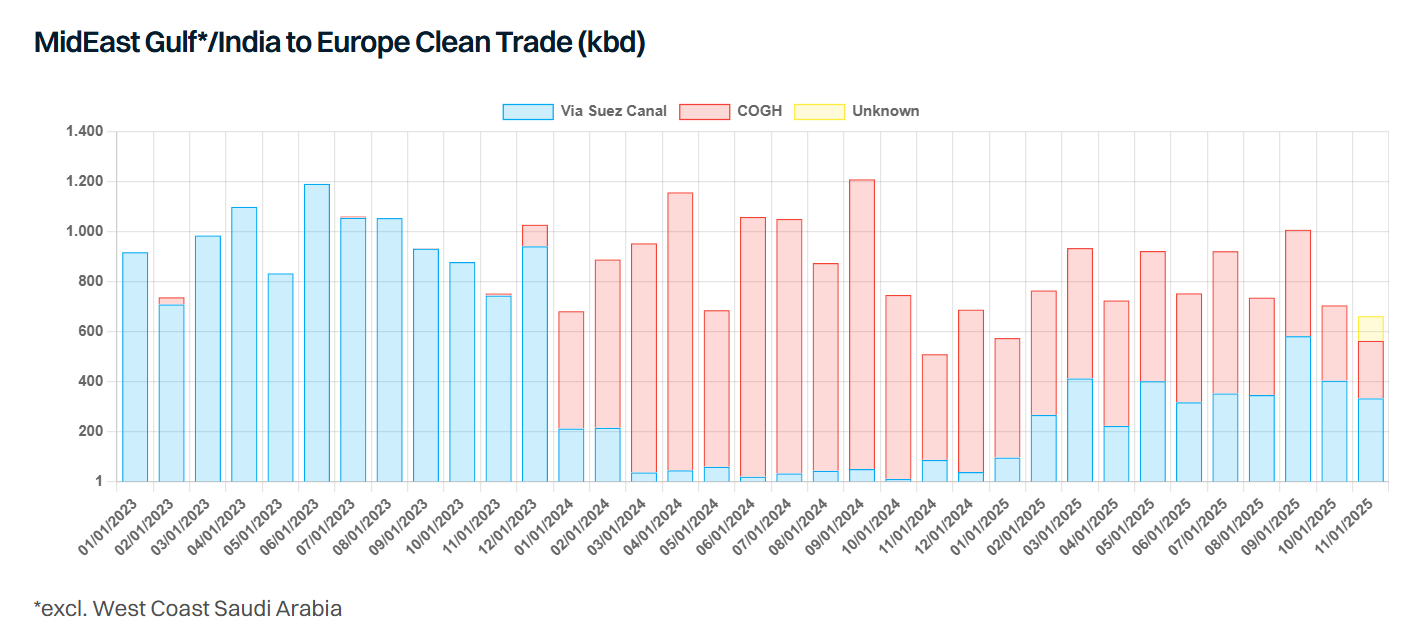
Data source: Gibson Shipbrokers