

China closed 2025 with headline economic growth broadly in line with official objectives, offering a sense of macroeconomic continuity as the country prepares to transition into the 15th Five-Year Plan period. Official data released by the National Bureau of Statistics in January confirmed that gross domestic product expanded by 5.0 percent year-on-year, allowing Beijing to meet its stated growth target despite persistent domestic demand constraints and a complex external backdrop. In nominal terms, the economy reached RMB 140.2 trillion (approximately $19.6 trillion). While the headline figure signals stability, growth momentum softened as the year progressed. Quarterly data point to a gradual deceleration through the second half of 2025, reflecting policymakers’ preference for maintaining macro balance rather than deploying aggressive stimulus. From a shipping perspective, this moderation is critical: it suggests that underlying demand conditions were shaped less by short-term policy impulses and more by structural and sector-specific dynamics. For the dry bulk market, the relevance of China’s 2025 economic performance lies not only in aggregate GDP growth, but also in the composition of that growth and the evolving policy framework guiding activity into 2026 and beyond. Beneath the surface of stable macro indicators, China’s economy continues to rebalance toward industrial upgrading, export-oriented manufacturing, and services, with important implications for commodity demand and trade flows.
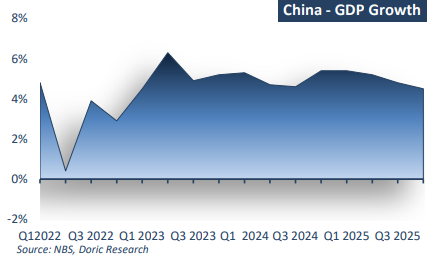
Industrial activity remained one of the more resilient pillars of growth throughout 2025. Value-added industrial output expanded at a pace exceeding overall GDP growth, supported primarily by manufacturing. In particular, equipment manufacturing and hightechnology segments significantly outperformed traditional heavy industry, reflecting years of policy-driven capital allocation toward advanced production capacity. Output growth in sectors such as industrial automation, new energy vehicles, and high-end machinery highlights the continued evolution of China’s industrial base away from property-linked demand and toward productivity-led expansion. Toward year-end, industrial sentiment showed tentative signs of stabilization. The official manufacturing purchasing managers’ index returned to expansionary territory in December, suggesting that factory activity had begun to bottom out after a prolonged period of pressure. While this does not imply a cyclical upswing, it does indicate that downside risks to industrial output have moderated, supporting steady baseline demand for raw materials. Fixed asset investment contracted on a full-year basis, marking a significant inflection point in China’s growth model. The decline was overwhelmingly driven by the real estate sector, where investment fell sharply amid ongoing deleveraging, subdued home sales, and cautious developer behavior. By contrast, non-property investment remained broadly stable. Manufacturing investment posted marginal growth, while selected high-technology and strategic sectors recorded strong expansion. Overall, 2025 was characterized less by retrenchment than by structural reorientation.
The services sector continued to expand at a faster pace than the broader economy, reinforcing the longer-term rebalancing trend. Producer-oriented services – including logistics, information technology, leasing, and business services – recorded comparatively strong growth, benefiting from industrial upgrading and exportoriented activity. However, consumer-facing services exhibited more uneven performance, particularly in the second half of the year, as household spending remained constrained by income uncertainty and weak property-related wealth effects.
Consumption showed incremental improvement in 2025 but failed to emerge as a decisive growth engine. Retail sales expanded modestly, with services and online channels outperforming traditional goodsbased consumption. Urban areas remained the dominant source of consumption growth, although rural demand improved at a slightly faster pace from a lower base. The overall picture points to a slow and uneven recovery in household spending, insufficient to generate a consumption-led rebound.
China’s external sector remained a key stabilizing force. Goods trade expanded at a moderate pace, with exports outperforming imports and providing a critical offset to domestic demand weakness. Hightechnology exports delivered particularly strong gains, reflecting China’s improving competitiveness in value-added manufacturing and green-related industries. Trade with Belt and Road economies continued to expand faster than trade with traditional partners, further diversifying export destinations and supporting shipping demand across multiple trade lanes.
Macroeconomic stability was reinforced by moderate inflation and steady employment conditions. Consumer prices remained broadly flat, while producer prices stayed in negative territory for much of the year, reflecting excess capacity and weak pricing power. Employment indicators remained stable, with real income growth continuing at a moderate pace. This environment provides policymakers with scope to deploy targeted support measures without the constraints of inflationary pressure.
As China enters the first year of the 15th Five-Year Plan, policy priorities are becoming clearer. Authorities have signaled a more proactive fiscal stance, balanced by an emphasis on financial discipline at the local government level. Monetary policy is expected to remain moderately accommodative, with tools deployed selectively to support domestic demand, innovation, and small and medium-sized enterprises. Boosting domestic demand remains at the core of the policy agenda, though progress is likely to be incremental rather than transformative. Efforts will focus on income growth, targeted consumption incentives, and state-led investment. At the same time, policymakers are intensifying efforts to address structural inefficiencies, including fragmented regional markets and “involutionary” competition across key industries. Further market opening, particularly in services, and continued commitment to decarbonization objectives round out the policy framework for 2026. While these initiatives are unlikely to generate immediate growth acceleration, they provide longer-term support for trade integration and industrial restructuring.
Against this macroeconomic backdrop, the performance of the dry bulk market remains notable. Despite China’s economy expanding at a more moderate and structurally rebalanced pace, freight markets have entered 2026 with momentum clearly carried over from the strong conditions observed in late 2025. This resilience is particularly striking given that the opening months of the year are typically seasonally weak. Importantly, the later timing of the Chinese New Year in mid-February 2026 has so far proven supportive, allowing industrial activity, logistics, and cargo flows to remain largely uninterrupted through January and into early February.
Data source: Doric