
In this week’s Allied Quantumsea Research, we review the evolving iron ore market landscape as 2026 begins, focusing on the widening gap between price performance and underlying fundamentals. We examine the early implications of Simandou’s first shipments, assess China’s steel demand and inventory dynamics, and evaluate how these factors are shaping both iron ore pricing and Capesize freight markets.
Market Overview: Price Strength Versus Fundamentals
Iron ore markets entered 2026 showing a clear divergence between price performance and physical fundamentals. During January, benchmark prices rallied to multi‑month highs despite little evidence of improvement in steel demand and persistently elevated inventory levels across China.
Recent price strength has been driven largely by macro‑economic sentiment, speculative positioning, and expectations of potential policy support in China, rather than by any material tightening in supply–demand balances. Indicators from the steel sector remain weak, with subdued domestic consumption and ample port stockpiles continuing to cap near‑term physical demand. As a result, the current price structure appears fragile. Absent concrete stimulus translating into higher steel output or sustained demand recovery, iron ore prices remain exposed to downside risk.
Simandou: Transition From Future Risk to Active Supply
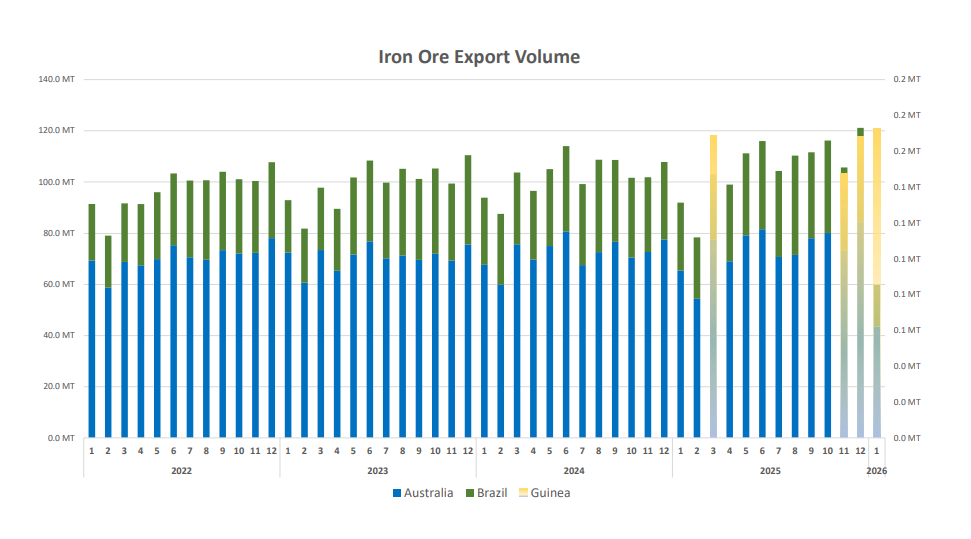
A notable development in January 2026 was the arrival of the first commercial iron ore shipment from the Simandou mine in Guinea at a Chinese port. A vessel carrying nearly 200,000 metric tons of high‑grade ore (approximately 65% iron) reached Majishan Port in Zhejiang Province after a voyage of roughly 46 days, marking Guinea’s entry into the seaborne iron ore trade after decades of development.
These initial volumes are small relative to global seaborne trade and will not materially alter near‑term supply balances. Production in 2026 is expected to remain limited, likely in the tens of millions of tonnes, with estimates centred around 15–20 million tonnes. This reflects early‑stage ramp‑up constraints, logistical sequencing, and operational scaling challenges. Consequently, Simandou’s immediate market impact is more symbolic than volumetric, confirming that a major new supply source is now operational rather than hypothetical.
The project’s longer‑term significance lies in its scale. Once fully ramped up, industry expectations suggest annual capacity could approach 120 million tonnes, positioning Simandou among the world’s largest iron ore producers. Over time, this high‑grade supply has the potential to reshape global trade flows and influence price dynamics, particularly if full ramp‑up coincides with continued weakness in global steel demand growth.
China Demand: Weak Steel Fundamentals Beneath Strong Import Flows
China remains the central driver of iron ore market direction, yet recent data highlight a persistent disconnect between import volumes and underlying steel demand.
Domestic steel consumption continues to decline, driven by the ongoing downturn in the property sector and policy efforts to curb excess capacity. Steel production levels remain subdued, and forward‑looking indicators point to further contraction through 2026.
In contrast, iron ore imports remain elevated, and port inventories have risen to multi‑year highs. This reflects inventory‑driven demand, restocking behaviour, and export‑oriented steel production rather than a recovery in domestic end‑use consumption. While this dynamic can support prices in the short term, it also increases market fragility, as elevated inventories can quickly shift sentiment once mill intake slows or liquidity conditions tighten.
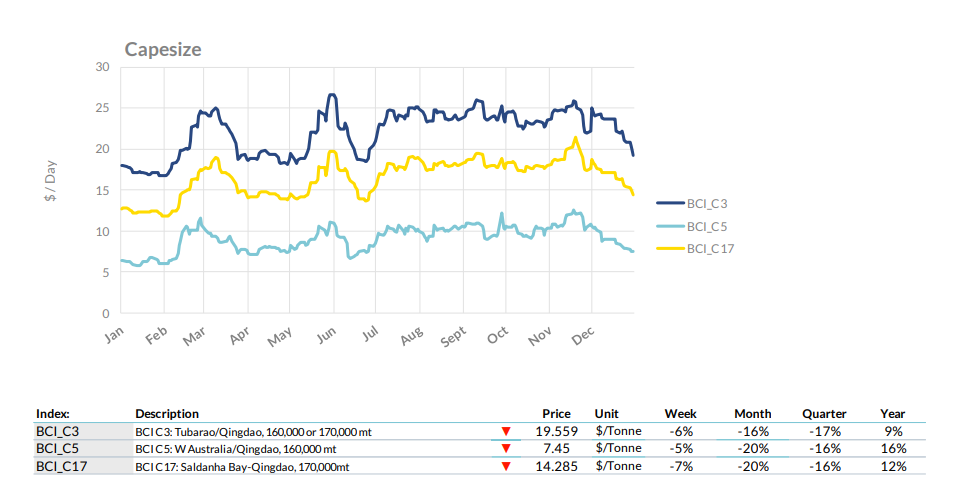
Capesize Market Update: Seasonal Headwinds and Fundamental Softness
The Chinese New Year period represents a recurring seasonal inflection point for dry bulk markets, particularly for iron ore‑linked Capesize demand. During the holiday window, industrial activity, port operations, and chartering activity typically slow, resulting in thinner liquidity and more selective fixing.
This year’s later Chinese New Year extends the pre‑holiday trading period; however, Capesize freight earnings weakened through January.
Following a sharp correction from late-2025 highs, Capesize freight rates have recorded a rebound at the opening of this week, with the Capesize Timecharter Average (C5TC 182) recovering to around USD 21,000–22,000/day after recently testing levels closer to USD 20,000/day. This move appears to reflect a short-term improvement in sentiment following the previous days of drop and not yet a change in underlying fundamentals. As such, the durability of any recovery will need to be confirmed by sustained fixing activity and firmer cargo demand in the days ahead.
At this stage, Chinese New Year should be viewed as an amplifying factor rather than the primary driver of weakness. Elevated iron ore inventories and subdued steel production suggest that underlying demand conditions remain the dominant influence on freight market performance.
Looking ahead
January 2026 reflects a market where iron ore prices have held up in the short term, mainly supported by sentiment rather than strong underlying demand. In contrast, steel fundamentals and freight markets continue to point to softer conditions.
The start of exports from Simandou is an important longer-term development. While it is unlikely to affect market balance immediately, it adds to expectations of greater iron ore supply over time. Combined with weak Chinese steel demand and seasonal headwinds, the overall outlook remains cautious.
Data Source: Allied