
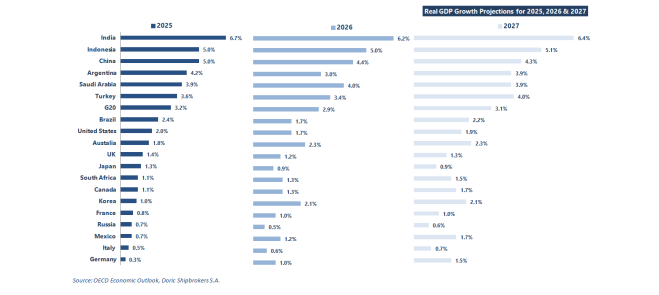
The global economy has once again demonstrated an impressive degree of resilience, continuing a trend first signalled by the OECD around this time last year. Back then, the organisation highlighted that easing inflationary pressures and a steady, if uneven, recovery across major regions were underpinning moderate global growth. The outlook at the time projected global GDP to rise by 3.2 percent in 2024 and 3.3 percent in both 2025 and 2026. Twelve months on, the OECD’s updated assessment confirms that global economic performance in 2025 has indeed been firmer than anticipated, although underlying fragilities remain. According to the new outlook, growth is expected to soften over the second half of the year as the temporary boost from front-loaded activity fades. At the same time, significantly higher effective tariff rates on imports between the U.S. and China are set to feed further into business costs and retail prices, acting as a brake on investment and trade. Rising geopolitical tensions and elevated policy uncertainty will continue to weigh on domestic demand across many economies. Even with these headwinds, the medium-term outlook remains constructive. The OECD expects global growth to regain momentum through 2026 as the drag from tariffs gradually diminishes, financial conditions turn more favourable, macroeconomic policies become increasingly supportive and inflation eases further. The projection foresees global growth easing from 3.2 percent in 2025 to 2.9 percent in 2026, before rebounding to 3.1 percent in 2027. Further reductions in interest rates are anticipated, while very limited fiscal tightening is expected. Inflation in the G20 is forecast to moderate to 2.8 percent in 2026 and 2.5 percent in 2027, down from 3.4 percent this year. In the U.S., output growth is projected to cool as the cumulative impact of steep tariff increases and lower net immigration becomes more pronounced. Once these effects pass their peak and monetary policy easing continues, growth should strengthen again, supported by sustained investment linked to artificial intelligence and other high-tech sectors. GDP growth is forecast at 2.0 percent in 2025, 1.7 percent in 2026 and 1.9 percent in 2027. The euro area faces a similar but more muted trajectory. Growth is forecast to ease from 1.3 percent in 2025 to 1.2 percent in 2026 before recovering to 1.4 percent in 2027. Increased trade frictions will weigh on activity, although improved financial conditions, ongoing investment linked to the Recovery and Resilience Facility and still-resilient labour markets are expected to provide a meaningful offset. In China, the OECD expects growth to remain steady at 5 percent in 2025 before slowing to 4.4 percent in 2026 and 4.3 percent in 2027. Strong precautionary savings will continue to dampen consumption, while real estate investment is expected to contract further. The government’s anti-involution campaign, aimed at curbing excessive competition and addressing overcapacity, will weigh on corporate investment. Yet infrastructure development should accelerate under the new Five-Year Plan beginning in 2026. Key projects include the mega-scale hydropower dam on the Yarlung Tsangbo river in Tibet, with annual spending equivalent to around 1 percent of GDP over the next five years. Export performance, however, will remain constrained by the latest US tariff increases. Monetary policy is expected to remain cautious, with limited space for further reductions in lending rates. India continues to stand out as one of the world’s fastest-growing major economies.
Real GDP is projected to expand by 6.7 percent in FY 2025-26, 6.2 percent in FY 2026-27 and 6.4 percent in FY 2027-28. While higher US tariffs will weigh on export growth, private consumption will benefit from rising real incomes as domestic inflation stays low and consumption taxes decline. Investment will be buoyed by lower borrowing costs and sustained public capital outlays. Strong economic momentum continues, although the widening trade deficit remains a point of caution. Elsewhere in Asia, Indonesia’s economy is forecast to grow by 5.0 percent in both 2025 and 2026, picking up to 5.1 percent in 2027. The recovery has strengthened on the back of robust household consumption and positive contributions from net exports. Looking ahead, lower inflation and easing financial conditions are expected to support both consumption and investment, although slowing export growth amid heightened global trade frictions will act as a headwind.
In Brazil, real GDP is projected to increase by 2.4 percent in 2025 before slowing to 1.7 percent in 2026 and then rising to 2.2 percent in 2027. Domestic demand will be the key growth pillar, supported by ongoing job creation and strong wage dynamics. However, elevated interest rates and broader global uncertainty will continue to constrain investment. Brazilian exports could face pressure from higher US tariffs if maintained, though strong agricultural output and rising food prices are expected to provide some offset. Risks to the outlook remain significant, particularly if global uncertainty intensifies or if Chinese import demand softens more sharply than expected. Australia continues to experience gradually strengthening growth, increasingly driven by private-sector activity. GDP is projected to expand by 1.8 percent in 2025 and accelerate to 2.3 percent in both 2026 and 2027. While global trade disruptions continue to weigh on sentiment, Australia’s major exports have held up relatively well. A sustained rise in gold prices would further boost the country’s terms of trade, lifting gold toward the top tier of Australian export earners.
Turning to global trade, growth is anticipated to reach 4.2 percent in 2025, reflecting stronger-than-expected front-loading in the first half of the year. This momentum is only partly unwinding as investment- and technology-related trade remains robust. Trade growth is expected to moderate to 2.3 percent in 2026 as the full impact of higher tariffs materialises, before recovering to 2.8 percent in 2027. The composition of trade is shifting, with emerging-market economies accounting for a larger share of global flows. South-East Asia’s role is expected to expand further, while China’s relative contribution moderates and advanced economies’ share continues to decline. Global growth has evolved more steadily than earlier anticipated, lending firmer support to dry bulk sentiment as the industry heads into the new year. The Capesize market’s rally to two-year highs has sharpened this shift in tone. Although challenges persist on the geopolitical and structural fronts, the macro setting is now aligned more favourably with dry bulk demand than implied by initial-year assessments.
Data source: Doric