

By Ulf Bergman
The past week saw the BDI extending on recent gains, with a strong performance for the Panamaxes more than offsetting losses in the other segments. Likewise, the commodities also experienced a week of mixed fortunes. The agricultural commodities and iron ore faced significant headwinds, while supply concerns contributed to gains for many energy commodities.
Macro/Geopolitics
The US dollar came under pressure on Friday, with the greenback declining by around half a per cent against a basket of foreign currencies. Weaker-than-expected labour market data contributed to increasing signs that the world’s largest economy is slowing down and weighed on the US currency. The disappointing jobs data followed the release of PMI data earlier in the week, which also failed to live up to market expectations. However, the unemployment rate remained very low and wage growth slowed by less than expected. Hence, the Federal Reserve may still see the need to hike interest rates further next month.
For the week ahead, there will be a focus on inflation, with data for the world’s two largest economies due for publication. China will release its readings on Wednesday, while the US will follow suit on Thursday. In addition, Chinese trade data for July will see the light of day on Tuesday.
Commodity Markets
Crude oil prices advanced last week as concerns over global supplies mounted amid reports that Saudi Arabia is extending its unilateral output reduction. The September Brent futures recorded a weekly gain of 2.2 per cent and ended Friday’s session at 86.24 dollars per tonne. However, the contracts have begun the new week in the red amid losses of around one per cent during today’s early trading.
European natural gas prices swung sharply throughout the past week, as supply disruptions unnerved markets at the same time as demand faced downward pressure. Nevertheless, despite a 5.3 per cent decline on Friday, the front-month TTF futures ended the week at 28.85 euros per MWh, 7.3 per cent higher than the previous Friday. Following Friday’s losses, the contracts have maintained the narrative of extensive volatility in today’s trading, with gains approaching four per cent.
Coal also experienced a volatile week, albeit to a lesser extent than natural gas. The futures for delivery in Rotterdam gained 1.2 per cent over the past week and settled at 109.50 dollars per tonne on Friday. In contrast, the front-month Newcastle contracts recorded a weekly decline of 1.2 per cent and ended the week at 140.50 dollars per tonne.
Uncertainty over the Chinese demand outlook amid weak economic growth and a lack of clarity over stimulus measures weighed on iron ore prices last week. After staging a minor recovery on Friday, the September futures listed on the Singapore Exchange recorded a 4.6 per cent decline last week, settling at 101.71 dollars per tonne. However, Friday’s positive momentum has failed to extend into today’s session, with the contracts trading marginally lower than last week’s close.
Base metals had a mixed week as the demand outlook remained uncertain amid mixed economic signals. The three-month copper and nickel futures listed on the LME declined by 1.0 and 4.5 per cent, respectively. On the other hand, the aluminium and zinc contracts recorded modest weekly gains, with the former advancing by 0.5 per cent and the latter edging up by 0.3 per cent.
The grain and oilseed futures trading on the Chicago Board of Trade faced significant headwinds last week as concerns over global supplies receded. Despite recording gains on Friday, the September wheat and corn futures dropped by 8.1 and 7.1 per cent, respectively, over the course of the week. In contrast, the soybean declined by 0.7 per cent on Friday, adding to a weekly decline of 4.8 per cent.
Freight and Bunker Markets
Spot freight rates for the different dry bulk segments developed along diverging paths last week. A strong showing for the Panamaxes offset losses in the other segments, and the Baltic Dry Index advanced by 2.3 per cent over the past week. The sub-index for the Panamaxes rose by 16.2 per cent amid weaker supply. Despite gains during the middle of the week, the freight rate indicator for the Capesizes recorded a weekly loss of 0.7 per cent. The Handysizes also ended the week in the red amid a loss of 1,5 per cent. However, the Supramaxes were the past week’s weakest performers, with their sub-index declining by 5.2 per cent as demand remained on a downward trend.
The Baltic Exchange’s wet freight indices ended the week in the red, with all of the indicators delivering negative performances on Friday. Still, despite the weak ending, the indices for the clean tankers and the LNG carriers recorded weekly gains of 1.3 and 7.0 per cent, respectively. In contrast, the dirty tanker spot freight index declined by 8.4 per cent over the course of the week as concerns over global crude oil supplies weighed on sentiments. The LPG tankers also faced headwinds throughout much of the week and recorded a decline of 2.5 over the past five sessions.
Higher crude oil prices contributed to bunker fuels gaining ground last week in all of the major maritime hubs. The trading in VLSFO in Singapore delivered a weekly increase of 4.2 per cent, while Rotterdam and Houston saw gains of 5.2 and 2.8 per cent, respectively. For the MGO, the weekly gains were mostly even more significant. In Houston, the fuel advanced by 6.6 per cent, with Singapore and Rotterdam following at 5.9 and 4.9 per cent, respectively.
The View from the Shipfix Desk
The Baltic Exchange’s freight rate indicator for the Supramaxes has almost halved since its high for the year in late March. After staging a minor recovery amid higher demand during the first two weeks of July, the segment's index declined during the past fortnight. Following the brief peak in demand at the beginning of July, aggregate weekly cargo order volumes have been trending lower. A decrease in vessel supply has been insufficient to offset falling demand and support freight rates.
The lower demand for seaborne transportation onboard Supramaxes was, to a greater extent, driven by falling coal volumes. Weekly cargo order volumes for the fossil fuel have been declining over the past month, with the 7.8 million tonnes recorded last week nearly 50 per cent below the level seen at the beginning of July. However, not only coal weighed on demand for the Supramaxes. The segment has also seen a 23 per cent decrease in demand during the past month for shipments of agricultural commodities. Hence, as the two cargoes account for nearly half of the total order volumes, a recovery in freight rates for the segment remains dependent on a rebound in demand for seaborne transportation of coal and agricultural commodities.
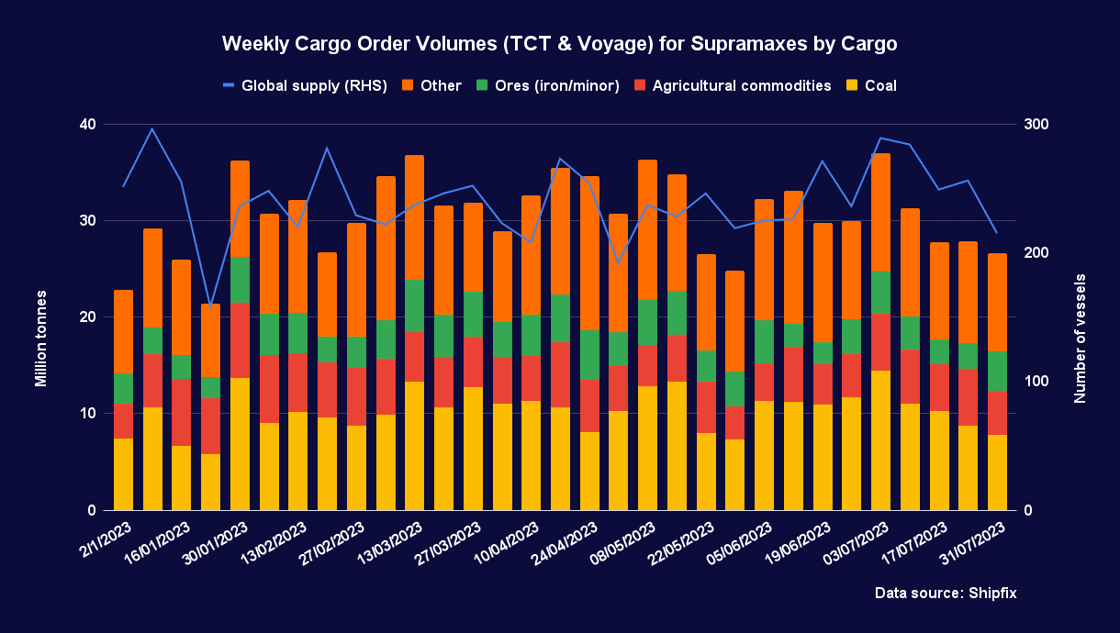
Data Source: Shipfix