
The Big Picture: El Niño: Risks to Dry Bulk Trades
Risk of disruption to dry bulk cargo supply in some key exporters from a 90% chance of El Niño ...
… but also some positives from an end to La Niña
Meteorologists predict El Niño, in tandem with climate change, will generate more extreme weather events.
There are precious few certainties in dry bulk shipping, so the World Meteorological Organisation (WMO)’s assessment on 4 July of a 90% probability of El Niño (of at least moderate strength) extending into the second half of 2023 gives us enough of a reason to a look at the potential consequences.
The resulting analysis does involve many “ifs”, “buts” and “maybes”.
Given the variety of weather effects associated with El Niño, the map produced by the National Oceanic and Atmospheric Administration (NOAA) in the US is useful. Although the effects vary from one event to the next, the NOAA notes that the strongest shifts remain fairly consistent in the regions and seasons below.
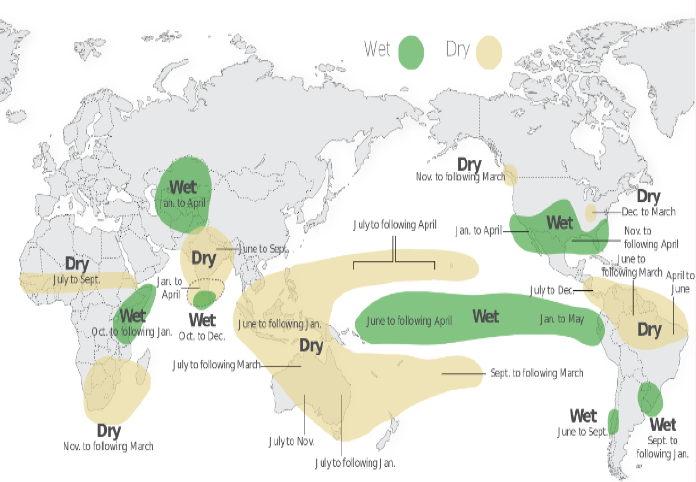
A couple of El Niño-linked developments have already happened. As we reported in our Research Update of 26 June, severe rainfall in Chile has impacted copper mining, which the NOAA notes is expected between June and September.
In contrast, El Niño is also associated with extreme dry conditions in the northern regions of South America. This week coal media carried reports that a state of emergency had been declared in one area of Colombia, which is also home to a major coal mine. As mining activity consumes a lot of water, there has been speculation that the environmentally conscious president of Colombia may restrict coal production.
While these two examples have negative implications for cargo supply and therefore ship demand across a range of bulker sizes, there would also be some positives.
One such would be the return of dry conditions on the eastern side of Australia after three consecutive years of heavy rains associated with La Niña.
The resulting extraordinary supply squeeze from Australia helped propel FOB prices of prime hard coking coal above $500/t at one stage (in March 2022) with 6,000kc Australian steam coal rocketing above $400/t in the second half of 2022, according to McCloskey.
For comparison, the five-year averages from 2015-19 inclusive for those grades of Australian coal have been around $160-165/t and $75-80/t, respectively.
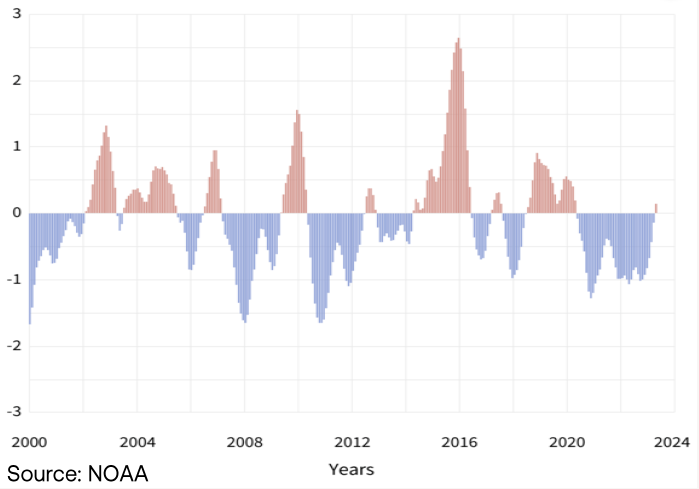
The NOAA’s Oceanic Niño Index (above) effectively shows El Niño events in red and La Niña in blue.
These blue troughs of La Niña activity have corresponded with extreme rainfall events in Eastern Australia highlighted on the graph on Page 2.
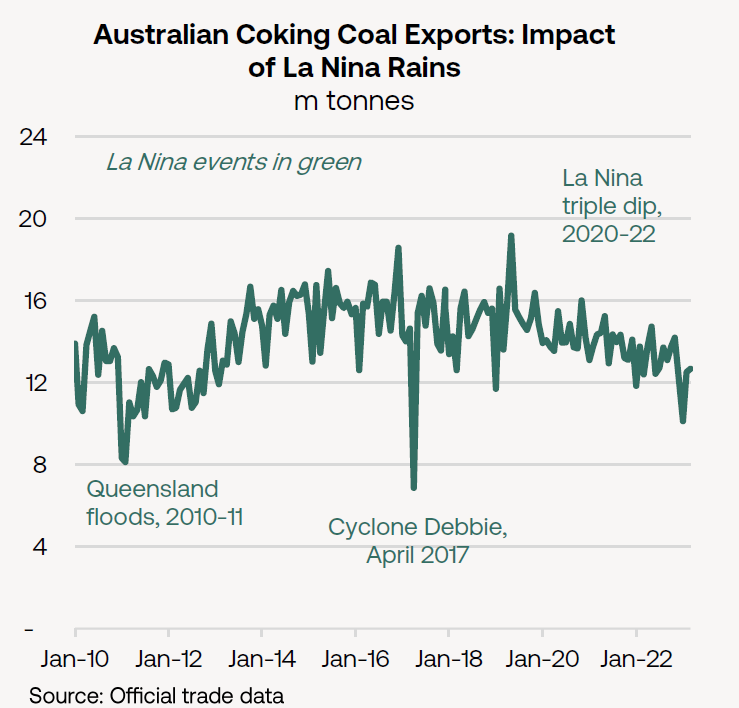
The chart, right, demonstrates three significant shocks to Australian coking coal supply since 2010: (1) the Queensland floods of 2010-11, (2) Cyclone Debbie of April 2017 and (3) the last three years of La Niña.
Twelve years ago, extensive flooding across Queensland, the world’s largest source of coking coal, from November 2010 to January 2011 reduced coking coal exports (including semi-soft grades) from Australia by 16% from 159m tonnes in 2010 to 133m tonnes in 2011—and drove coking coal FOB prices above $300/t for the first time ever.
If wet weather abates, with the arrival of El Niño, it is reasonable to assume production and supply chain operations can improve between July and next January.
The chart hints that—demand permitting, of course—a monthly average of, say, 14-16m tonnes would physically be achievable, as opposed to the 2023 January-April average of 11.8m tonnes.
For Capes and Panamaxes, this would create more opportunities for trade, the only downside being the currently subdued steel sector demand in East Asia
More speculatively, the NOAA associates El Nino with dry weather across West Africa during the Q3. This may lessen the impact of the rainy season (which usually takes place between July and October) on bauxite supply from Guinea, a significant driver of Capesize and Panamax demand in the mid-Atlantic.
There may also be logistical issues resulting from El Niño. For the southern states of the US, heavy rainfall and flooding could cause issues along the Mississippi River and other waterways between November and April.
The El Niño Southern Oscillation is not the only factor determining climatic conditions and, from a shipping perspective, it would be premature to draw a conclusion whether its arrival would have bullish or bearish consequences for the market. We have, however, selected five examples of potential change, each significant in their own right.